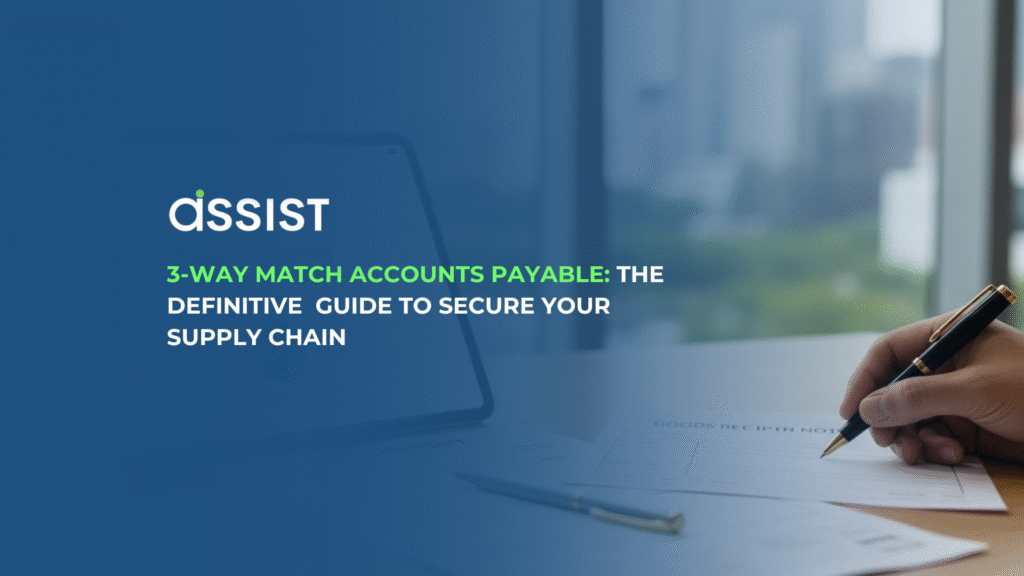

The 3-way match in accounts payable is a foundational internal control process that cross-references a purchase order, a goods receipt, and a vendor invoice to ensure payment accuracy and prevent fraud. By verifying that the quantities and prices across all three documents align perfectly, businesses can eliminate overpayments and maintain a reliable audit trail. In this guide, we will break down exactly how to implement this workflow, handle discrepancies, and transition to automation to secure your financial operations. Let’s explore these steps together to ensure your business remains compliant and efficient.
What is 3-Way Matching? The Trio of Truth
At its core, 3-way matching is a verification technique used by teams to ensure that a payment is only made when three specific documents align: the Purchase Order (PO), the Goods Receipt Note (GRN), and the Supplier Invoice.
- The Purchase Order (PO): This is the contract that states what you intended to buy and at what price.
- The Goods Receipt Note (GRN): This is your physical proof of delivery, confirming what actually arrived at your warehouse or office.
- The Supplier Invoice: This is the formal request for payment.
By reconciling these three, you ensure you aren’t paying for goods you never ordered or items that never arrived. To master this, you must first understand the difference between accounts payable and accounts receivable to see how your internal liabilities are managed against your incoming cash.
Regional Nuances and Compliance
For businesses operating in trade hubs, the 3-way match serves a dual purpose: internal control and tax compliance. With the mandatory transitioning to e-invoice Malaysia on the horizon, the digital trail created by 3-way matching becomes even more vital for audits. The “Goods Receipt” is often a formal document requiring high levels of accuracy to be legally binding in a dispute.
The Perspective for Secondary Markets
While the core 3-way match remains the same, your “Needs Met” rating for internal audits will require higher scrutiny on pricing variances in different regions. Vendors often use different payment terms, and missing a 3-way match discrepancy can lead to costly late fees or strained vendor relations. For firms juggling dual-market operations, exploring a practical buyer’s guide for Accounts Receivable management software can help manage the other side of the ledger with equal precision.
Experience in Action: Solving Discrepancies
High-quality content requires “Experience,” which is the first-hand knowledge of how these processes work in the real world. Consider a scenario where a firm receives 1,000 units of electronics. The PO says 1,000, the Invoice says 1,000, but the GRN shows only 950 arrived due to damage in transit. A manual system might miss this 50-unit discrepancy, costing the company thousands. We saw this firsthand in our case study for the food industry, where automated reviews caught pricing variances that human eyes missed during peak season.
Moving from Manual to Automated 3-Way Matching
The biggest threat to 3-way matching is human error. Manual matching is slow and prone to mistakes. This is where how AI will impact accounting becomes a tangible reality. By utilizing OCR for invoice data extraction, your system can automatically pull data from a PDF invoice and compare it against your digital PO and GRN in seconds.
Setting Up Your Approval Matrix
Not every discrepancy requires a full halt. Expert-led organizations set “tolerance levels.” For example, a 2% price variance due to shipping fluctuations might be acceptable. Defining these rules is easier when you have a structured user guide for the approval matrix that dictates which senior manager needs to sign off on larger mismatches.
Conclusion: The Path to Financial Integrity
Mastering the 3-way match is not just an accounting task; it is a foundational pillar of a healthy, reliable business. By ensuring your documents align, you protect your reputation and your bottom line. Ready to eliminate manual errors and secure your cash flow? Register for using Assist solution and try it for free at https://app.assist.biz/auth/register.