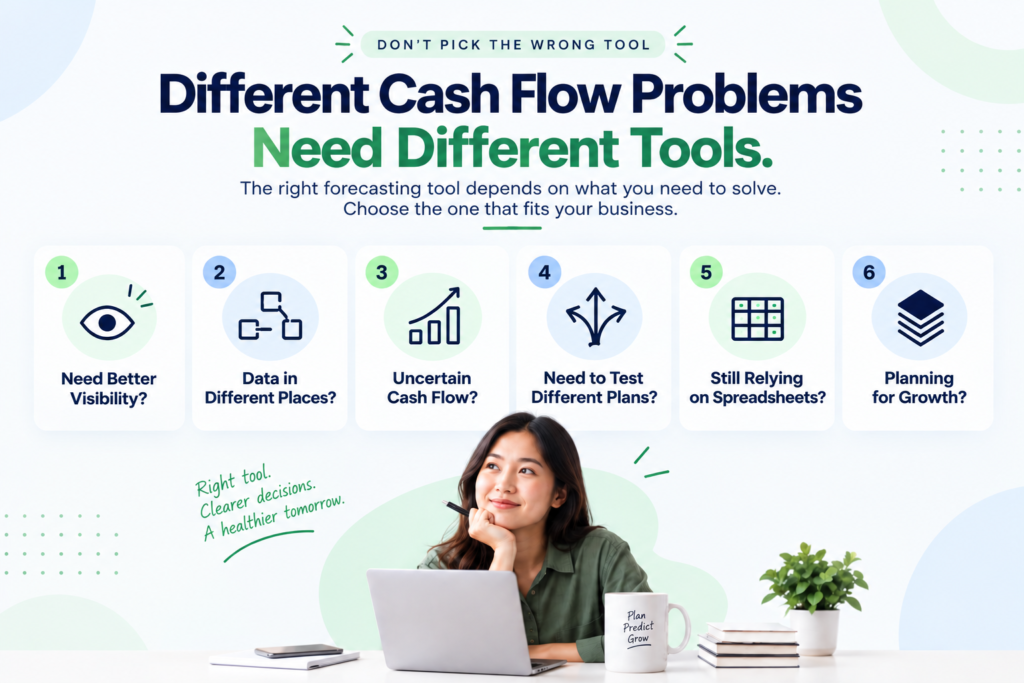






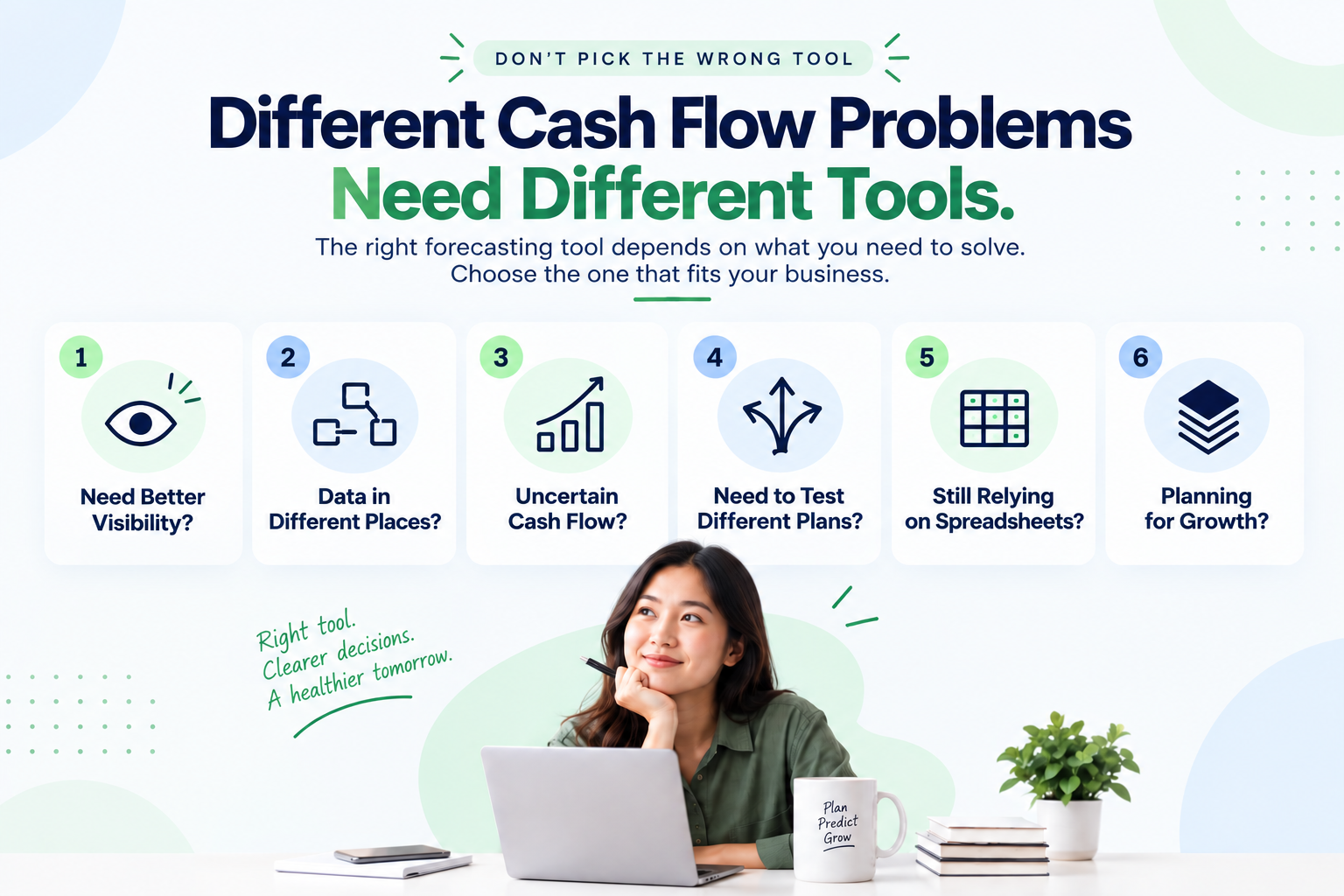

The best cash flow forecasting software for SMEs in 2026 depends on the job it needs to do. Float suits straightforward cash visibility, Fathom handles deeper three-way forecasting, Cash Flow Frog automates rolling forecasts, Dryrun focuses on scenario planning, while G-CashFlow and Syft Analytics suit businesses that need broader financial modelling.
Best cash flow forecasting software for SMEs in 2026 at a glance
There is no useful “best overall” answer. A Singapore SME trying to see whether it can cover payroll 10 weeks from now has different requirements from a regional company modelling several entities over five years.
The better question is: What financial decision does the forecast need to support?
| Software | Best for | Xero | QuickBooks | Scenario planning | Forecast depth | Pricing approach | Main limitation |
| Float | Straightforward cash visibility | Yes | Yes | Yes | Up to 36 months | Subscription | Direct integrations focus mainly on Xero and QuickBooks |
| Fathom | Three-way forecasting and financial analysis | Yes | Yes | Yes | Up to 5 years | Per connected company | More financial depth than some small firms need |
| Cash Flow Frog | Automated rolling forecasts | Yes | Yes | Yes | Up to 36 months | Revenue-based tiers | Can be more than a very simple business needs |
| Dryrun | Scenario-led cash planning | Yes | Yes | Yes | Short and longer-range modelling | Check current vendor pricing | Better suited to active modelling than passive cash tracking |
| G-CashFlow | Google Sheets-based three-way forecasting | Yes | Yes | Yes | Three-way forecasts | From US$50/month for Business | Spreadsheet-style workflow will not suit everyone |
| Syft Analytics | Broader financial analysis | Yes | Yes | Yes | Weekly to long-range integrated forecasts | Tiered subscription | Wider analytics suite may be unnecessary for basic forecasting |
Product features and pricing can change. Treat the table as a shortlist, then confirm the current plan, supported accounting system and feature limits with each vendor before making a purchasing decision.
What should SMEs look for in cash flow forecasting software?
Cash flow forecasting software is a tool that estimates how money may enter and leave a business over a future period. It combines current financial information with assumptions about sales, expenses, invoices, bills and expected cash movements.
The definition matters because vendors solve different problems under the same “cash flow forecasting” label.
Cash tracking, forecasting and FP&A are different tools
Cash tracking is the monitoring of money available now and recent movements through the business.
Cash flow forecasting is the projection of future cash positions so management can anticipate shortages, surpluses and the effect of planned decisions.
FP&A software is a broader financial planning and analysis system. It may combine cash forecasts with budgets, financial statements, operational drivers, consolidated entities and longer-term scenarios.
Three-way forecasting goes deeper. It links projected profit and loss, balance sheet and cash flow statements so changes flow through an integrated financial model.
The distinction between money owed by customers and money owed to suppliers matters here too. SMEs that need a refresher can review the practical difference between accounts payable and accounts receivable, since both can materially affect the timing assumptions inside a cash forecast.
Not every SME needs three-way forecasting.
A company worried about paying suppliers and payroll over the next 13 weeks may get more value from a focused cash forecast than from a large FP&A platform. A growing regional business preparing budgets, financing plans or board reports may need the extra modelling.
Six buying criteria matter more than the feature count
Start with the accounting system where your financial records already live. If your business runs on Xero or QuickBooks, direct integration can reduce the manual work required to keep forecasts current. SMEs reviewing that setup can read this guide to integrating Xero and QuickBooks before assessing forecasting add-ons.
Then evaluate six points:
- Accounting integration. Does the forecasting product connect properly to your accounting system?
- Forecast horizon. Do you need visibility for 13 weeks, 12 months, three years or longer?
- Scenario planning. Can you test delayed payments, hiring, sales changes or major purchases without changing the base forecast?
- Forecasting depth. Do you need a cash projection or integrated three-way forecasting?
- Setup and maintenance. Who will review assumptions and keep the forecast useful?
- Does the additional forecasting capability justify the subscription at your current size?
The fifth point causes more trouble than feature comparisons suggest. More sophisticated software gives you more modelling options, but somebody still has to challenge the assumptions.
Forecasting is especially vulnerable to poor source data. If the bookkeeping process is slow or manual, the numbers feeding a forecast may already be out of date. This is why automated bookkeeping can reduce repetitive finance work even though bookkeeping automation and forecasting software solve different problems.
A polished forecast built on stale records or unrealistic customer payment dates can still give management the wrong picture.
The best cash flow forecasting tools for different SME needs
Float: best for straightforward cash visibility
Float is a good fit for SMEs that want to move beyond spreadsheet forecasting without building a full FP&A function.
Its Xero and QuickBooks connections make it useful for businesses that want cash forecasts tied closely to the accounting data they already maintain. Scenario planning also helps teams test events such as delayed customer payments, new hires or large purchases without changing the accounting records themselves.
This makes Float useful when the recurring questions are practical: What happens if our biggest customer pays a month late? Can we afford another employee? When does the bank balance become uncomfortable?
The trade-off is scope. Businesses using accounting platforms outside its supported ecosystem should verify compatibility before shortlisting it.
Fathom: best for deeper forecasting and three-way planning
Fathom is better suited to SMEs that need to understand how operating assumptions affect the wider financial picture.
Its forecasting approach supports three-way modelling, linking the profit and loss statement, balance sheet and cash flow statement. That depth can help growing businesses, advisers, management teams and companies with formal budgeting or financing requirements.
It can also be excessive. If the only requirement is to see whether cash gets tight next quarter, a simpler application may take less time to maintain and explain.
Finance teams considering this level of automation should also look at how their underlying accounting process works. The broader guide to AI bookkeeping and finance automation explains where automation can support bookkeeping workflows without treating every finance problem as a forecasting problem.
Cash Flow Frog: best for automated rolling forecasts
Cash Flow Frog centres on connecting accounting data to a rolling cash forecast.
Its appeal is straightforward: SMEs can spend less time copying actual figures into a forecast and more time reviewing what the updated numbers mean.
What-if scenarios allow a business to model events such as a delayed receivable, new employee or pricing change. This makes the software more useful when management wants to test decisions rather than simply look at the current bank balance.
For businesses where customer collections are the main source of cash uncertainty, forecasting software should be considered alongside the process used to manage outstanding invoices. A practical accounts receivable management software guide for US and APAC businesses provides useful context on the operational side of receivables.
Dryrun: best for scenario-led cash planning
Dryrun puts scenario modelling near the centre of the forecasting process.
That becomes useful when management regularly asks “what happens if?” A business may want to model a slower sales month, a large customer paying late, a planned hire, a second location or a temporary increase in supplier costs.
The friction is that scenarios need ownership. Someone must decide which assumptions are realistic and update them when conditions change.
A company that only wants a simple warning when cash may run low may not need this level of hands-on modelling.
G-CashFlow: best for spreadsheet-oriented three-way forecasting
G-CashFlow offers a different workflow. It connects accounting data to Google Sheets rather than forcing finance teams to abandon a spreadsheet environment they already understand.
That can suit an SME whose finance team is comfortable in Google Sheets but wants more structure around three-way forecasts and scenario modelling.
The same characteristic can rule it out. A business trying to get away from spreadsheet-style finance work may prefer a dedicated forecasting interface.
This is a useful reminder that automation should match the way a team works. The broader shift toward AI and automation in small-business tools does not automatically mean every manual workflow should be replaced with the most complex software available.
Syft Analytics: best for broader financial analysis
Syft Analytics extends beyond basic cash forecasting into reporting, consolidation, budgeting and financial analysis.
That makes it more relevant to SMEs with a finance function that wants forecasting and management analysis in one environment. It can also be useful to regional groups that need to review several entities rather than a single operating company.
The trade-off is breadth. An SME that only needs a simple rolling cash balance may end up paying for and maintaining an analytics environment that goes well beyond the original problem.
Which cash flow forecasting software should your SME choose?
Choose around the problem, not the longest feature list.
If you mainly need simple cash visibility, start with software designed to make short and medium-term cash movements easy to inspect.
If management frequently tests hiring, pricing, delayed payments or growth plans, give scenario planning more weight.
If you need the P&L, balance sheet and cash flow statement to move together, shortlist software with three-way forecasting.
If your business has no dedicated FP&A team, setup effort matters just as much as forecasting power. A tool nobody maintains will not improve the quality of your decisions.
Your accounting stack can narrow the choice further. Xero-based businesses should check exactly what a forecasting application imports, how frequently it refreshes and whether the connection is read-only. QuickBooks users should ask the same questions.
For more background on how accounting data moves between systems, SMEs can review Assist’s guides to Xero-connected accounting workflows and QuickBooks-connected accounting workflows. These integrations do not replace forecasting software, but they illustrate why data flow matters when several finance tools need to work together.
When Excel or Google Sheets may still be enough
A spreadsheet can still be reasonable for a small business with predictable income, few accounts and limited scenario requirements.
The problems usually appear as the business grows. Someone starts copying actual figures into the model every week. Formula errors become harder to spot. Two people maintain different versions. Management wants to compare several scenarios, but changing one assumption breaks another part of the forecast.
Dedicated software does not make assumptions correct. It reduces some of the manual work involved in importing data, maintaining forecast structures and comparing scenarios.
The same principle applies to accounting processes surrounding the forecast. SMEs deciding whether to automate more of their finance function may find the explanation of how automated bookkeeping software supports business workflows useful before adding another platform to the stack.
What Singapore SMEs should consider before buying
Singapore SMEs should check the finance workflow before choosing a forecasting platform.
A forecasting system is only as useful as the information feeding it. If invoices, bills or reconciliations are consistently late, connecting them to sophisticated forecasting software does not remove that weakness.
Check accounting integration beyond the logo
“Integrates with Xero” or “works with QuickBooks” tells you little by itself.
Ask what information transfers, how frequently it refreshes, whether multiple entities are supported and whether the forecasting platform can modify accounting data.
The same review should cover accounts payable. Supplier bills and planned payment dates directly affect projected cash outflows, so businesses with high invoice volumes may also want to understand accounts payable invoice automation for APAC businesses before deciding how forecasting fits into the wider finance stack.
For an APAC business operating across several markets, multi-currency support and entity consolidation may matter just as much as the basic accounting connection.
Factor Singapore’s digital finance environment into the wider stack
Cash forecasting does not operate in isolation. Invoicing, accounts receivable, accounts payable, bookkeeping and accounting data all influence how quickly actual financial activity reaches the forecast.
Singapore SMEs reviewing that wider workflow may find it useful to understand InvoiceNow in Singapore alongside their accounting and forecasting setup. E-invoicing is not a cash forecasting feature. It is one part of the flow of financial information that eventually reaches accounting records and management reports.
Companies with more complex supplier controls may also find the Singapore-focused explanation of two-way matching in accounts payable useful when reviewing how invoice verification, payment timing and cash planning fit together.
Cash forecasts are management tools, not guarantees of future liquidity. Their usefulness depends on the quality of the underlying records and assumptions. Businesses making material financing, solvency, tax or investment decisions should consider advice from an appropriately qualified professional.
Choose software around the cash decisions you need to make
The best cash flow forecasting software for SMEs in 2026 is the product that answers the company’s recurring cash questions at a level of effort the team can sustain. Simple businesses may need visibility rather than advanced modelling. Growing SMEs may benefit from scenarios or three-way forecasting. Regional businesses may need multi-entity and multi-currency support.
Reliable forecasts also depend on timely accounting data. For Singapore and APAC SMEs looking beyond forecasting to reduce manual finance work, Assist’s AI bookkeeping capabilities provide an option to assess alongside its finance automation features and pricing. If your broader goal is to assess finance automation and AI readiness, talk to an infrastructure specialist about AI readiness.
Frequently asked questions
What is the best cash flow forecasting software for SMEs in 2026?
The best cash flow forecasting software for SMEs in 2026 depends on the business’s forecasting needs. Float suits straightforward cash visibility, Fathom supports deeper three-way forecasting, Cash Flow Frog automates rolling forecasts, Dryrun focuses on scenario planning, G-CashFlow suits spreadsheet-oriented teams, and Syft Analytics offers broader financial analysis.
What should a Singapore SME look for in cash flow forecasting software?
A Singapore SME should assess accounting-system compatibility, forecast horizon, scenario planning, setup effort, pricing, multi-currency requirements and the finance expertise needed to maintain the forecast. Businesses operating across APAC should also check regional integration availability and multi-entity support.
Is Xero or QuickBooks enough for cash flow forecasting?
Xero or QuickBooks may be enough when an SME only needs relatively simple cash planning. Dedicated forecasting software becomes more useful when the business needs longer forecast horizons, scenario comparison, more control over payment assumptions, integrated financial modelling or consolidated forecasts.
What is three-way cash flow forecasting, and does an SME need it?
Three-way cash flow forecasting links projected profit and loss, balance sheet and cash flow statements in one financial model. An SME may need it for deeper budgeting, financing or management reporting. A smaller business focused mainly on short-term liquidity may be better served by a simpler cash forecast.
How far ahead should an SME forecast cash flow?
An SME should match its forecast horizon to the decision being made. A rolling 13-week forecast is useful for near-term liquidity management, while 12-month and multi-year forecasts can support budgeting, hiring, financing and investment decisions.
Is cash flow forecasting software better than Excel for SMEs?
Cash flow forecasting software becomes more useful than Excel when manual updates, formula errors, version control or scenario maintenance start consuming significant time. Excel or Google Sheets can remain suitable for a small, predictable business with a simple forecast and disciplined financial record-keeping.
How much does cash flow forecasting software cost for a small business?
Cash flow forecasting software ranges from relatively inexpensive SME subscriptions to substantially more expensive products with deeper forecasting, reporting or multi-entity capabilities. Pricing may depend on users, companies, annual revenue or features, so SMEs should compare the plan they need rather than the lowest advertised price.