





For large enterprises, supplier invoice processing is more than an administrative task. It is a critical part of maintaining financial accuracy, controlling expenses, and ensuring suppliers are paid correctly.
Consider a company managing thousands of invoices every month across different departments, subsidiaries, and countries. Some invoices arrive by email, others through supplier portals, and some still require manual data entry. When purchase orders do not match, approvals are delayed, or duplicate invoices slip through, finance teams spend valuable time investigating problems instead of focusing on higher-value work.
These challenges become even more significant for enterprises operating across Singapore and Malaysia, where businesses must manage different tax requirements, accounting practices, and e-invoicing frameworks.
In 2026, supplier invoice processing automation offers enterprises an opportunity to improve efficiency without compromising financial control.
This guide explores how supplier invoice processing works, the most common enterprise challenges, practical best practices, and how AI-powered automation tools can support more accurate, scalable accounts payable operations.
What Is Supplier Invoice Processing?
Supplier invoice processing is the workflow businesses use to receive, verify, approve, record, and prepare supplier invoices for payment.
It forms part of accounts payable (AP), which manages an organization’s outstanding financial obligations to vendors and suppliers.
A typical supplier invoice includes the supplier’s details, invoice number, transaction date, purchase order reference, goods or services provided, payment terms, and applicable taxes.
For enterprise finance teams, processing these documents involves more than checking whether the amounts are correct. Each invoice must also comply with internal purchasing policies, approval requirements, and relevant tax regulations.
Understanding the difference between accounts payable and accounts receivable helps clarify how supplier invoice management fits into the broader financial process.
How Does the Supplier Invoice Processing Workflow Work?
A structured workflow helps enterprises manage large invoice volumes while maintaining consistency across departments and business entities.
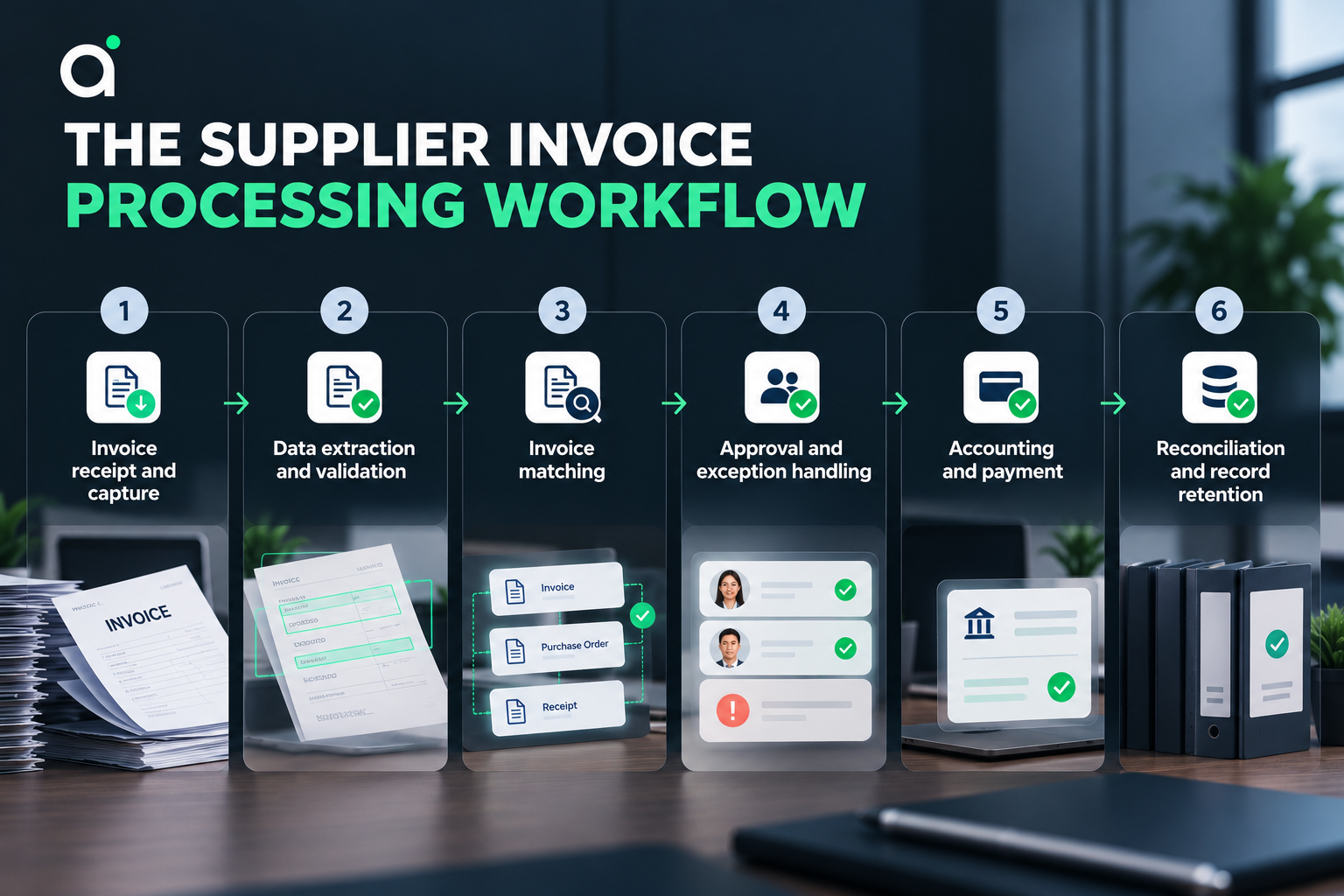
Invoice receipt and data capture
Supplier invoices may arrive as PDFs, scanned documents, email attachments, or structured electronic invoices.
Traditional processing requires employees to manually transfer invoice details into accounting systems. This increases repetitive work and creates opportunities for errors.
Modern tools use optical character recognition (OCR) and AI-assisted extraction to capture information automatically. However, as explained in this comparison of OCR and AI invoice automation, recognizing text is only one part of building a reliable invoice workflow.
Validation, matching, and approval
Once invoice information is captured, it should be checked against supplier records and supporting documents.
Two-way matching compares an invoice with its purchase order. Three-way matching adds the goods receipt or equivalent confirmation of delivery.
For example, if a supplier invoices 500 units but the warehouse records only 450 received, the discrepancy should be investigated before payment.
Enterprises can use three-way matching controls to reduce discrepancies and strengthen procurement-to-payment accountability.
Approved invoices are then recorded in the ERP or accounting system, prepared for payment, reconciled, and retained for audit purposes.
Common Supplier Invoice Processing Challenges for Large Enterprises
High invoice volumes and disconnected systems
Large organizations often manage supplier invoices across several subsidiaries, departments, and finance systems.
When each team follows a different process, finance leaders may struggle to obtain a consistent view of outstanding invoices, approval delays, and supplier liabilities.
Manual errors and duplicate invoices
Incorrect invoice amounts, inconsistent supplier names, missing purchase order references, and duplicate submissions can create significant processing delays.
Duplicate invoices are particularly concerning because a payment error may not be discovered until reconciliation.
Complex approval structures
Enterprise invoices frequently require authorization from multiple stakeholders.
Without clear approval ownership, invoices can remain pending while finance employees repeatedly follow up with department managers.
A well-defined invoice approval matrix can establish approval limits and reduce unnecessary delays.
Limited visibility into AP operations
When invoice records are scattered across spreadsheets, inboxes, and separate accounting systems, finance teams may struggle to identify overdue approvals or upcoming payment obligations.
This limits the ability to forecast cash requirements and manage supplier relationships proactively.
How AI and Automation Improve Supplier Invoice Processing
AI is changing how enterprises handle repetitive invoice tasks, particularly when dealing with large volumes of unstructured financial documents.
Unlike basic automation that follows fixed rules, AI-assisted systems can interpret invoice information, suggest classifications, and identify unusual transaction patterns.
| Process | Manual approach | AI-assisted approach |
| Invoice capture | Manual data entry | Intelligent data extraction |
| GL coding | Employee selects accounting categories | AI suggests relevant categories |
| Duplicate detection | Manual checks or exact matching | Potential duplicate and similarity detection |
| Invoice matching | Manual document comparison | Automated matching and exception alerts |
| Approvals | Email-based follow-ups | Rules-based routing and reminders |
| AP reporting | Periodic spreadsheet reviews | Centralized dashboards and exception monitoring |
Example: AI-assisted invoice exception handling
Consider a Malaysian manufacturing group receiving a supplier invoice for RM125,000 against an approved purchase order of RM120,000.
An automated system can identify the RM5,000 difference, flag the invoice, and route it to procurement or finance.
The reviewer can then investigate whether the difference relates to additional charges, revised pricing, or an invoicing error.
Instead of manually reviewing every invoice, finance teams can focus on exceptions requiring judgment.
The objective is not to remove human oversight. It is to make financial controls more efficient and consistent.
For shared services centres managing invoices across several business entities, this approach can improve visibility and reduce repetitive administrative work.
Supplier Invoice Processing Compliance in Singapore and Malaysia
For enterprises operating across Singapore and Malaysia, supplier invoice automation must support different regulatory frameworks. Although both countries are advancing electronic invoicing, their requirements and implementation models differ.
Singapore: GST InvoiceNow requirements
Singapore’s InvoiceNow network uses the international Peppol standard to enable structured electronic invoicing between businesses.
The Inland Revenue Authority of Singapore (IRAS) is progressively requiring GST-registered businesses to transmit relevant invoice data through InvoiceNow-Ready Solutions.
The implementation schedule is:
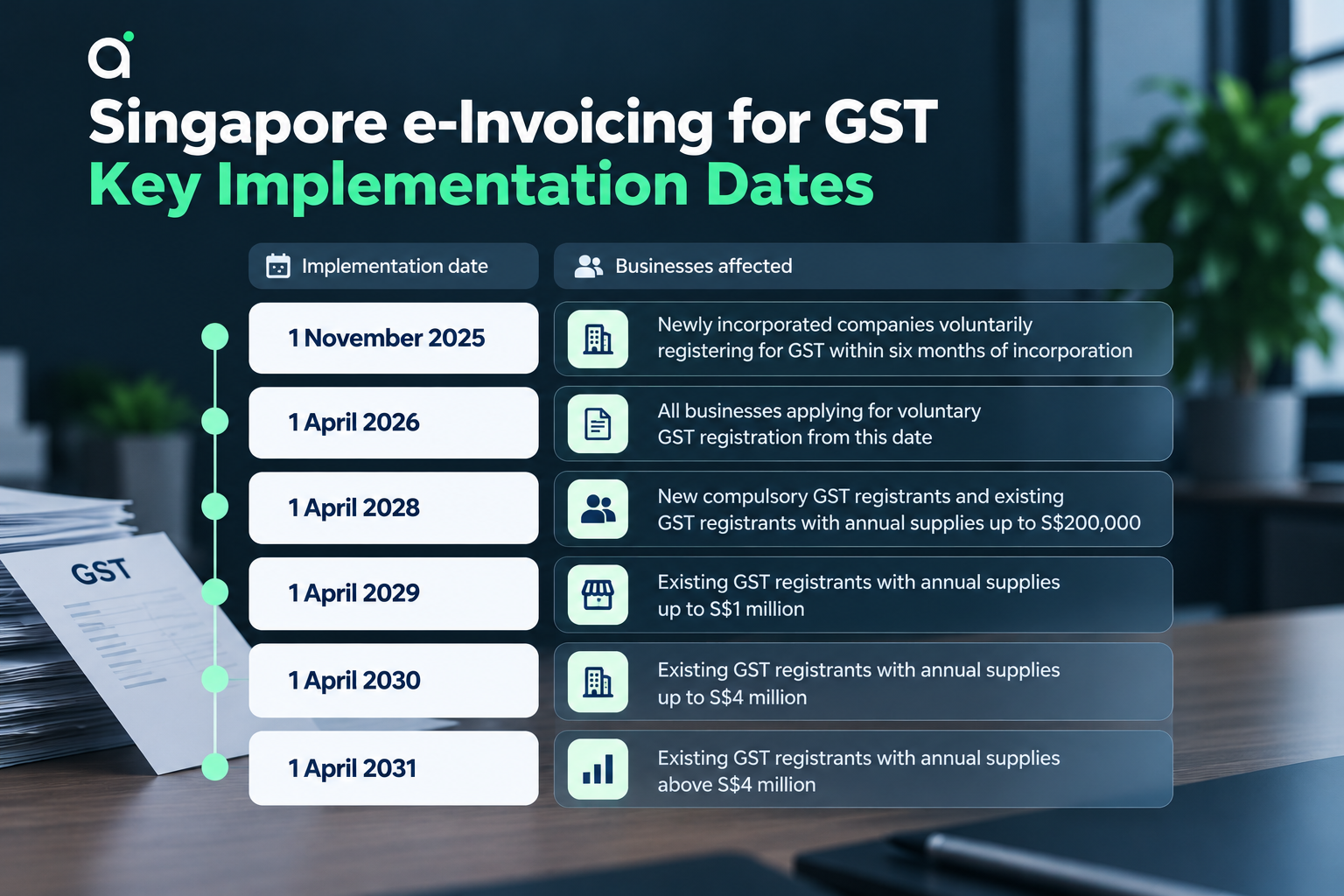
For existing GST registrants, the annual supplies thresholds are based on prescribed accounting periods ending in 2025.
Although many larger existing enterprises have until April 2031 under the published schedule, early preparation is important, particularly for businesses using customized ERP systems.
Enterprise finance teams should assess their invoice data quality, system compatibility, Peppol connectivity, and GST reconciliation processes.
IRAS also requires relevant purchase and sales invoice data to be transmitted by the earlier of the GST return filing date or its statutory filing deadline.
For more context, enterprises can explore how InvoiceNow works in Singapore and its role in digital invoice management.
Malaysia: LHDN MyInvois requirements
Malaysia’s e-Invoice framework is administered by the Inland Revenue Board of Malaysia (LHDN) through MyInvois.
The implementation began with larger businesses and expanded to smaller taxpayers in subsequent phases.
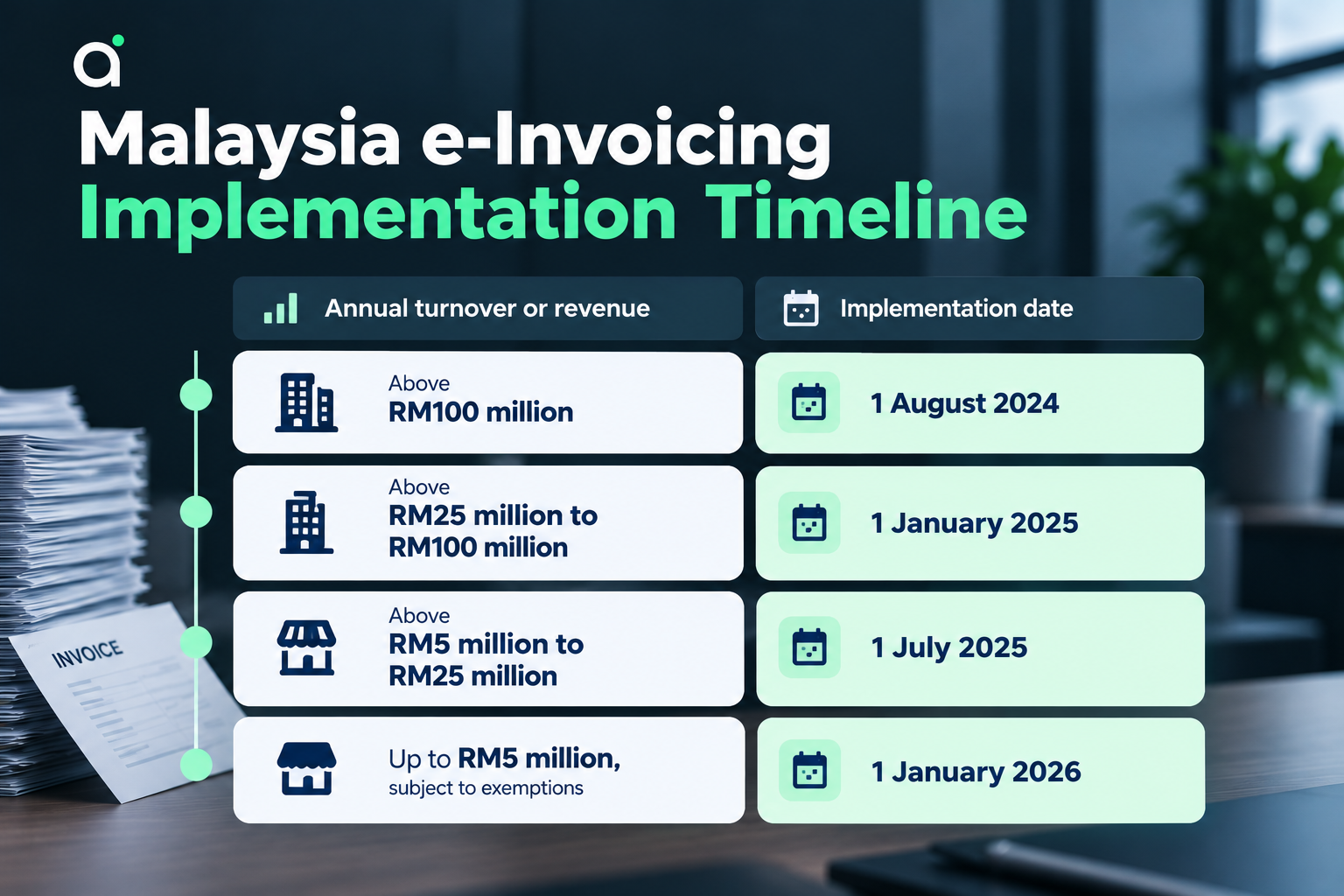
The official implementation timeline, updated on 30 August 2026, provides an exemption for taxpayers with annual turnover or revenue below RM3 million. Eligibility may depend on additional conditions, including corporate group relationships.
For large Malaysian enterprises, the priority is ensuring that invoice records remain accurate, validated, and consistent across financial systems.
Important considerations include supplier tax identification numbers, document validation, credit and debit notes, self-billed transactions where applicable, and accounting reconciliation.
A detailed understanding of Malaysia’s e-Invoicing compliance requirements can help finance teams align invoice workflows with regulatory obligations.
It is important to distinguish e-invoicing from AP automation. E-invoicing supports structured invoice exchange and regulatory validation or reporting. AP automation manages the broader internal process, including invoice matching, approvals, accounting entries, and payment preparation.
How to Choose the Right Supplier Invoice Automation Tools
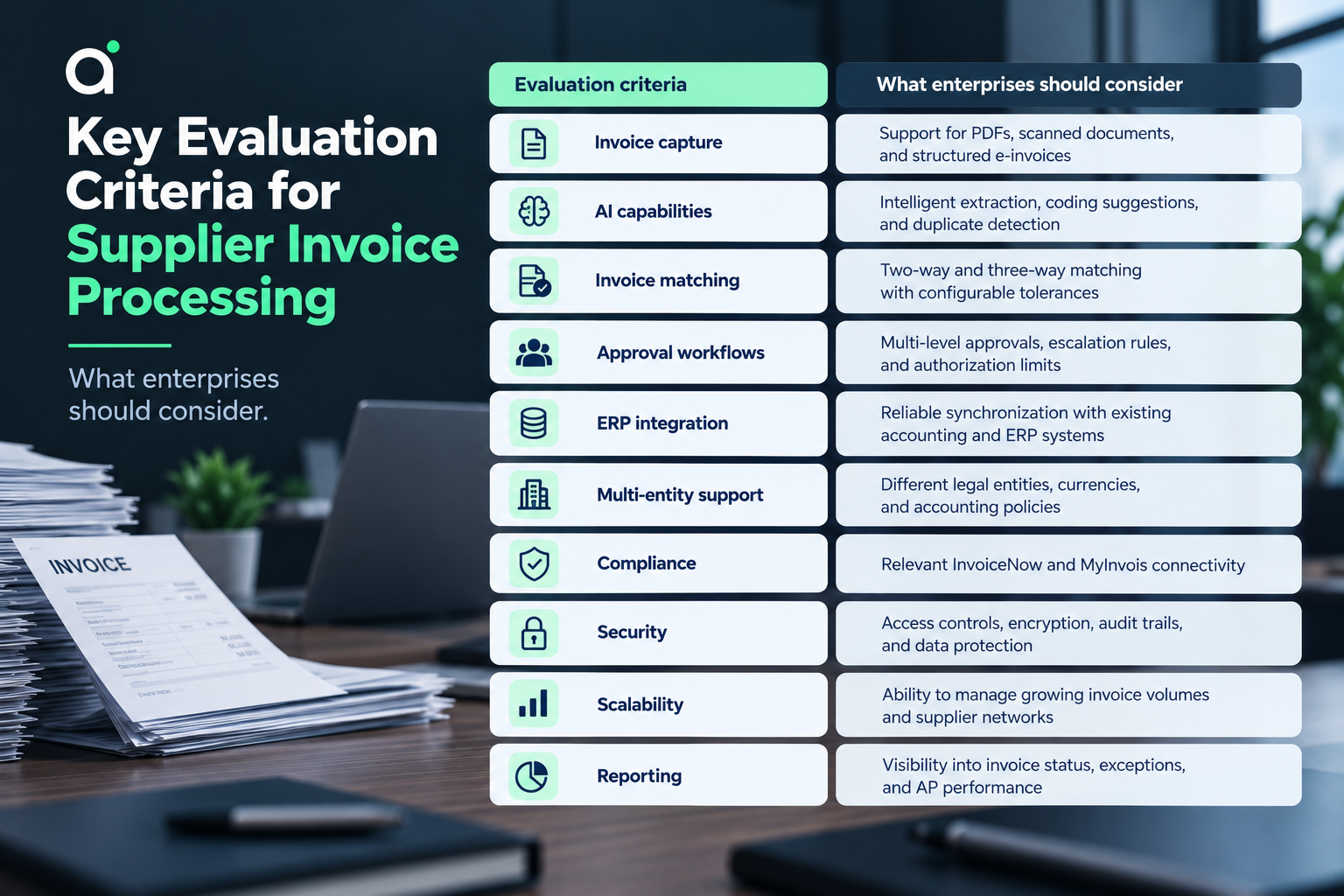
Selecting an invoice automation platform requires more than comparing document extraction features.
Enterprise finance teams should evaluate whether a solution can support complex workflows, integrate with existing systems, and maintain appropriate controls as transaction volumes grow.
Types of supplier invoice automation software
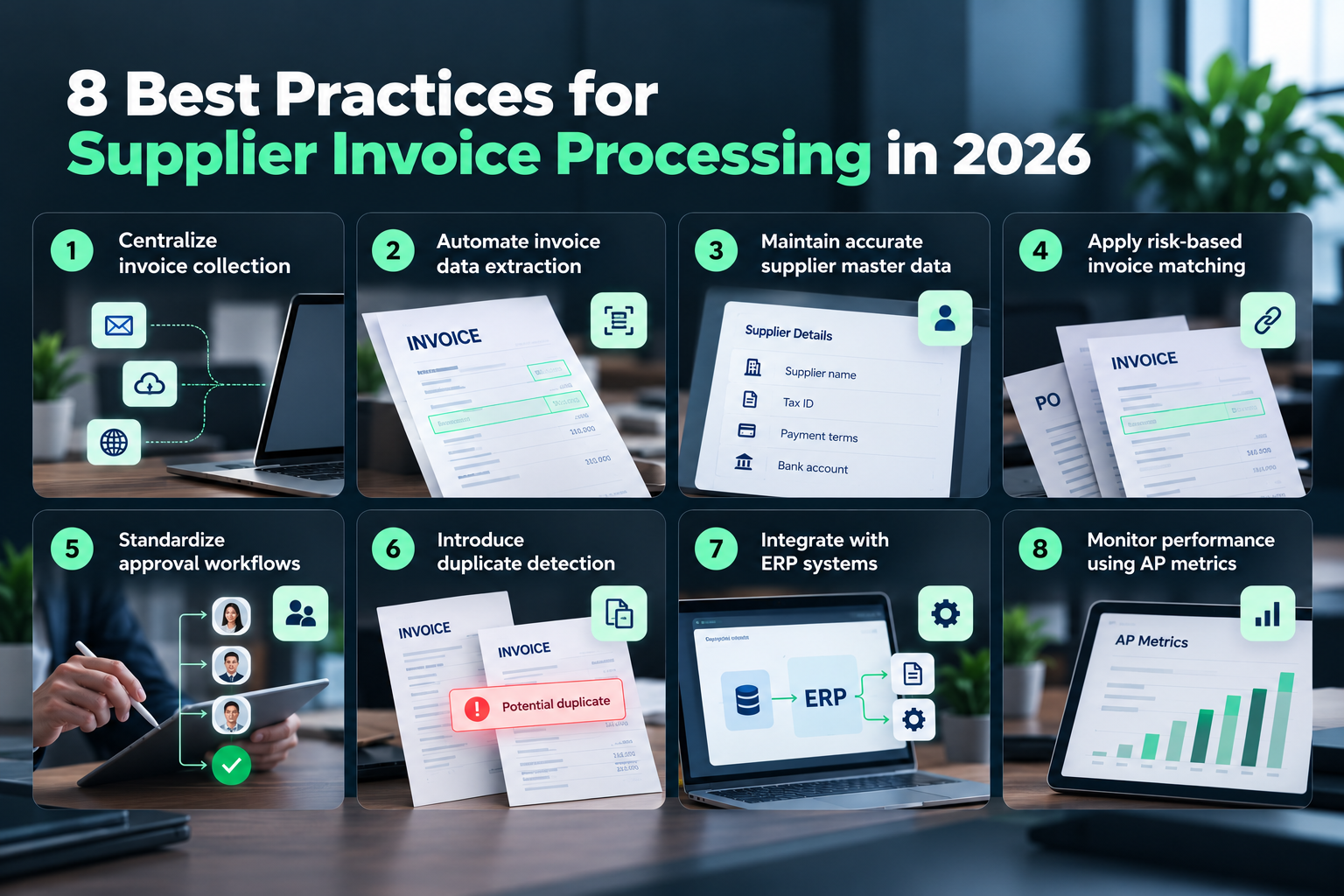
ERP-native AP automation: Enterprise platforms such as SAP and Microsoft Dynamics 365 provide invoice processing within broader financial management environments. These may be suitable for organizations seeking close integration with procurement and accounting processes.
Specialist accounts payable automation: Dedicated AP platforms focus on document capture, invoice matching, approval routing, and supplier management. Some support integration across multiple ERP environments.
AI-powered document processing: These tools specialize in extracting and interpreting invoice information, particularly when suppliers submit documents in different formats.
The right choice depends on the organization’s existing technology, internal controls, integration requirements, and long-term finance strategy.ree3plier Invoice Automation
Automation should deliver measurable improvements, not simply replace one manual process with another system.
Finance leaders can evaluate performance using several key metrics.
| KPI | What it measures |
| Cost per invoice | Average processing cost for each supplier invoice |
| Processing cycle time | Time between invoice receipt and approval |
| Touchless processing rate | Percentage of invoices processed without manual intervention |
| Exception rate | Percentage requiring additional investigation |
| On-time payment rate | Percentage paid within agreed terms |
| Duplicate payment prevention | Confirmed duplicate payments avoided |
Consider an enterprise processing 10,000 supplier invoices monthly.
If the average processing cost decreases from S$8 to S$3 per invoice, the potential annual gross savings would be:
10,000 invoices × (S$8 − S$3) × 12 months = S$600,000
This is an illustrative calculation, not a guaranteed result. Actual savings depend on implementation costs, software fees, transaction complexity, and achievable process improvements.
For large organizations, a phased rollout can reduce implementation risk. Starting with one department or business entity allows teams to validate workflows before expanding automation across the enterprise.
Frequently Asked Questions
What documents are needed to process a supplier invoice?
At minimum, the supplier invoice and its matching purchase order. Three-way matching also requires a goods receipt or equivalent delivery confirmation.
How can enterprises automate supplier invoice processing?
Enterprises can use OCR, AI-assisted data extraction, automated invoice matching, approval workflows, duplicate detection, and ERP integration to reduce repetitive work and improve consistency.
What is three-way matching in invoice processing?
Three-way matching compares a supplier invoice with the purchase order and goods receipt to verify pricing, quantities, and delivery before payment approval.
Can AI completely replace manual invoice reviews?
Not entirely. AI can automate routine processing and identify discrepancies, but high-risk transactions, unusual exceptions, and sensitive changes should remain subject to appropriate human oversight.
Is supplier invoice automation the same as e-invoicing?
No. E-invoicing focuses on structured electronic invoice exchange and relevant compliance obligations. Supplier invoice automation covers the broader invoice-to-payment workflow.
Conclusion: Building a More Efficient Enterprise AP Process
Supplier invoice processing plays an essential role in maintaining financial accuracy, payment controls, and operational efficiency.
For enterprises managing multiple entities and high transaction volumes, standardized workflows and AI-assisted automation can help reduce repetitive tasks, identify discrepancies earlier, and provide better visibility into outstanding obligations.
As Singapore and Malaysia continue advancing their e-invoicing frameworks, finance leaders should also ensure their systems support the relevant regulatory requirements.
For organizations considering supplier invoice processing automation, ASSIST’s finance automation solutions provide a starting point for exploring invoice capture, approval workflows, and accounting integration.
If your team is assessing its AI readiness, get started with ASSIST to discuss how automation could fit your existing finance operations.