





For many Malaysian SME owners, e-Invoicing has raised a familiar question: “Does this actually apply to my business?”
You may have heard that LHDN’s Phase 3 deadline was in July 2025. Then came further implementation changes, relaxation periods, and a new RM3 million exemption threshold. With so many updates, it is understandable that businesses are still trying to work out what they need to do.
The important thing to know is that LHDN e-Invoice requirements in 2026 depend on your business’s annual turnover, exemption eligibility, and applicable implementation date.
Some SMEs must already comply, while others may qualify for exemption. And even if your business is exempt, maintaining accurate financial records remains essential.
This guide breaks down the latest deadlines, exemption rules, and practical steps Malaysian SMEs can take to manage e-Invoicing confidently.
What Is LHDN E-Invoicing and How Does It Work?
An e-Invoice is a structured digital record of a transaction between a supplier and buyer. Under Malaysia’s e-Invoicing framework, relevant transaction information is submitted to the Inland Revenue Board of Malaysia (LHDN) for validation through MyInvois.
It is different from simply creating a PDF invoice and emailing it to a customer.
A PDF may look professional, but that alone does not make it an LHDN-validated e-Invoice. A validated e-Invoice contains structured information that can be processed and verified electronically.
The process generally involves five steps:
- Create: Prepare an invoice containing the required supplier, buyer, and transaction information.
- Submit: Send the invoice through the MyInvois Portal or an integrated system.
- Validate: LHDN checks the submitted information and returns a validation result.
- Share: Provide the validated e-Invoice or its permitted visual representation to the buyer.
- Maintain records: Keep the necessary documents for accounting, reconciliation, and tax purposes.
Validated e-Invoices receive a unique identifier, and a QR code can provide access to their validation information.
If your business is new to the system, understanding how MyInvois works in Malaysia is a useful starting point.
LHDN E-Invoice Phase 3 and the Updated 2026 Deadlines
One of the biggest misconceptions is that Phase 3 is still approaching.
In reality, LHDN e-Invoice Phase 3 officially began on 1 July 2025, covering businesses with annual turnover or revenue above RM5 million and up to RM25 million.
Since then, the implementation framework has evolved, particularly for smaller businesses.
Malaysia E-Invoice Implementation Timeline
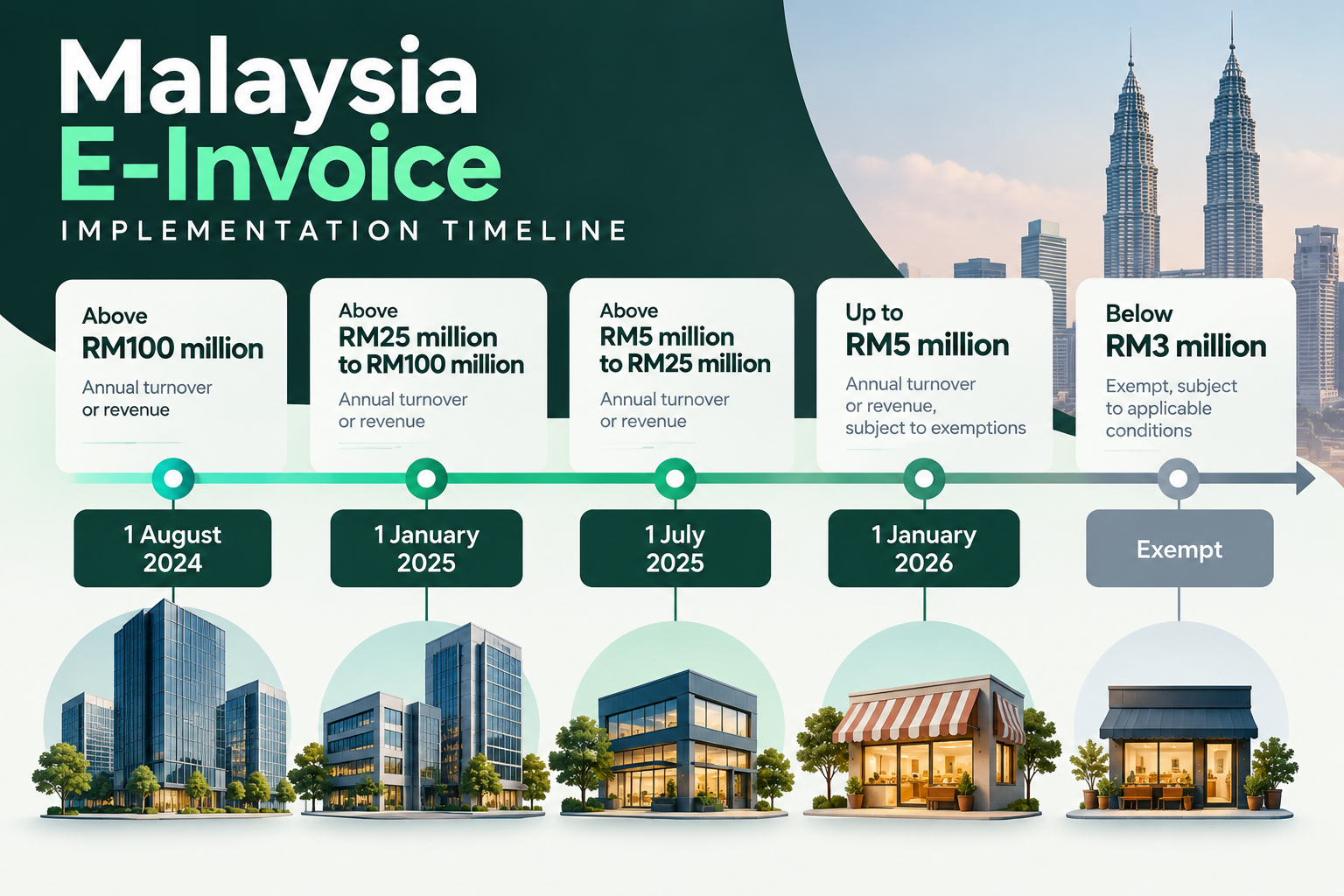
Source: LHDN’s official implementation timeline, updated 30 August 226.
What About the Relaxation Period?
An implementation date and a relaxation period are not the same thing. The implementation date determines when a business is required to begin complying with e-Invoicing requirements. A relaxation period provides limited flexibility for certain procedures, subject to LHDN’s conditions.
For example, qualifying businesses may be allowed to issue consolidated e-Invoices for specified transactions during the applicable transitional period.
However, this does not mean businesses can ignore their e-Invoicing responsibilities until the relaxation period ends.
Phase 3’s published interim relaxation period ended on 31 December 2025. For businesses covered by the 1 January 2026 implementation phase, LHDN has published transitional arrangements extending to 31 December 2027, subject to the relevant conditions. For additional context, explore Malaysia’s e-Invoicing requirements for 2026.
Who Qualifies for the RM3 Million E-Invoice Exemption?
One of the most significant developments in 2026 was LHDN’s decision to increase the e-Invoice exemption threshold to annual turnover or revenue below RM3 million.
The updated threshold, announced on 30 August 2026, provides relief for qualifying smaller businesses.
But there is an important distinction: earning less than RM3 million does not necessarily mean every business automatically qualifies for exemption.
Why Your Business Structure Matters
Exemption eligibility may also depend on the relationship between your business and other companies.
LHDN’s exemption framework includes considerations involving non-individual shareholders, holding companies, subsidiaries, and related companies.
This matters because a small business operating independently may have a different compliance position from a company belonging to a larger corporate group.
Consider these examples.
Example 1: Independent Retail Business
A family-owned retailer generates RM1.8 million in annual revenue.
If it satisfies the relevant exemption conditions, it may qualify for exemption from mandatory e-Invoicing.
However, the owner should continue maintaining proper sales records and monitoring whether the business’s circumstances change.
Example 2: Subsidiary of a Larger Company
A company generates RM2.5 million annually but is owned by a larger corporate group.
Although its individual turnover falls below RM3 million, its ownership structure may affect exemption eligibility.
The company should therefore verify the applicable related-company conditions before assuming it is exempt.
Businesses should refer to the latest LHDN guidance, particularly because some earlier FAQs still contain examples based on previous exemption thresholds.
For further clarification, read this guide to e-Invoice exemption rules in Malaysia.
7 Things Malaysian SMEs Should Prepare for E-Invoice Compliance
Whether your business is preparing to implement e-Invoicing or reviewing an existing process, the following checklist can help identify potential gaps.
Confirm Your Implementation Date and Exemption Status
Start by reviewing your annual turnover or revenue and determining which implementation category applies.
If your business earns below RM3 million, check whether it meets the relevant exemption criteria, including any conditions relating to corporate ownership.
For businesses already issuing e-Invoices, verify whether subsequent regulatory changes affect their obligations before changing existing procedures.
Verify Your TIN and MyInvois Access
Your Tax Identification Number (TIN) is an important part of the e-Invoicing process.
Make sure your business information is accurate and that authorised employees have access to the appropriate MyInvois functions.
The MyInvois Portal is accessible through MyTax, and LHDN provides a testing environment to help businesses familiarise themselves with the system.
For guidance, refer to the process for registering for the MyInvois Portal.
Organise Customer and Supplier Information
Imagine preparing 100 invoices at month-end, only to discover that several customer records contain incomplete or outdated information.
That creates unnecessary administrative work.
Before submitting e-Invoices, review relevant customer and supplier details, including names, TINs, identification information, addresses, and other required fields.
Keeping this information organised can reduce submission problems and prevent repeated corrections.
Review Mandatory E-Invoice Fields
An e-Invoice requires more than a customer name and total amount.
Depending on the transaction, mandatory information may include invoice identification details, supplier and buyer information, item descriptions, classification codes, tax information, currency, and transaction totals.
The exact requirements vary according to the transaction and document type.
Understanding the mandatory e-Invoice fields in Malaysia helps businesses prepare accurate records before submission.
Choose the Right Submission Method
LHDN provides the free MyInvois Portal, allowing businesses to submit e-Invoices without purchasing commercial software.
The portal also supports prescribed batch-upload methods for businesses processing multiple documents.
Alternatively, businesses with higher transaction volumes may consider systems that integrate with MyInvois through an API.
The right option depends on invoice volume, existing accounting processes, available resources, and operational requirements.
Whichever method you choose, test common transaction scenarios before relying on it for daily operations.
Train Employees and Establish Clear Responsibilities
E-Invoicing should not become the responsibility of one employee who happens to understand the system.
Finance, sales, and administrative teams may all play a role in collecting information, preparing invoices, reviewing submissions, and correcting errors.
Establish clear responsibilities so employees know who handles each stage.
A documented process also helps maintain consistency when staff members are absent or new employees join the business.
Maintain Accurate Records and Reconciliation
Successfully submitting an e-Invoice is only one part of financial management.
Businesses still need to reconcile invoices with sales records, customer payments, credit notes, and accounting entries.
Supporting documentation must also be retained according to applicable recordkeeping requirements.
For SMEs operating across several APAC markets, remember that Malaysia’s MyInvois requirements are different from e-Invoicing frameworks in Singapore and other jurisdictions.
A consistent internal recordkeeping process can support both compliance and financial visibility.
Common MyInvois Errors and How to Handle Them
Even businesses with established procedures may occasionally encounter validation errors.
Common problems include:
- Incorrect or invalid Tax Identification Numbers.
- Missing or incomplete buyer information.
- Incorrect invoice field formats.
- Tax calculation inconsistencies.
- Duplicate submissions.
- Incorrect document references.
The first step is identifying whether the invoice was rejected during submission or had already been successfully validated.
What If an E-Invoice Has Already Been Validated?
Under LHDN’s documented procedures, a validated e-Invoice can generally be cancelled within 72 hours of validation, subject to the applicable conditions.
After the cancellation window, corrections may require an appropriate credit note, debit note, or refund note e-Invoice.
For example, if a business discovers an incorrect invoice amount after the cancellation period, it should follow the applicable adjustment procedure rather than simply deleting the original transaction.
The correct document depends on the nature of the adjustment.
For more practical guidance, explore the common e-Invoicing challenges faced by Malaysian businesses.
Ultimately, preventing errors through accurate information and consistent checks is more efficient than repeatedly correcting submissions.
Manual vs Automated E-Invoicing: Which Is Better for SMEs?
Not every Malaysian SME needs a complicated invoicing system.
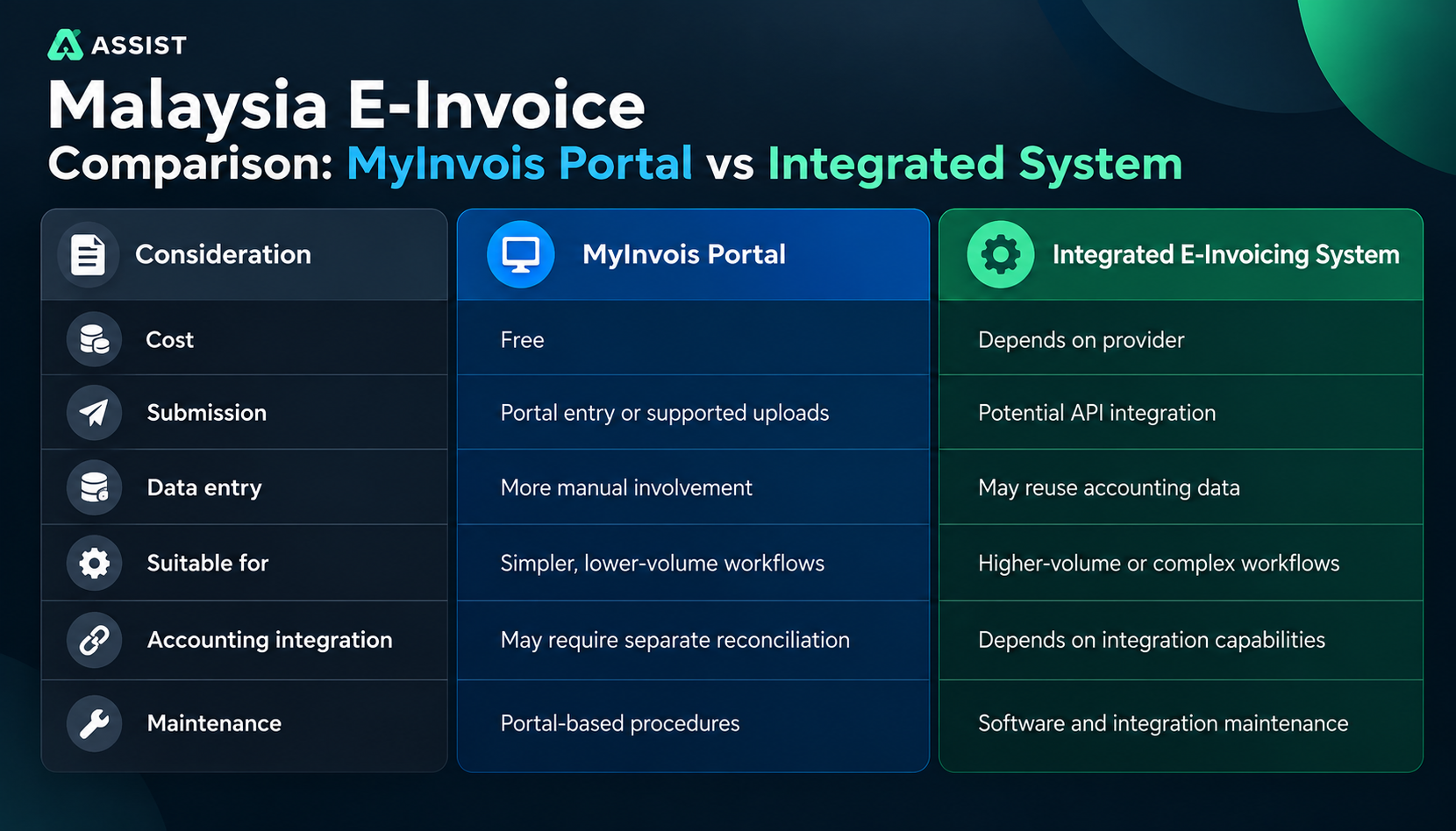
A small business issuing a limited number of invoices each month may find the free MyInvois Portal sufficient.
However, a distributor processing hundreds of invoices, managing multiple customers, and reconciling transactions across accounting systems may need a more integrated workflow.
Here is a practical comparison.
LHDN also provides MyInvois e-POS, a free point-of-sale solution designed for micro, small, and medium enterprises.
Before choosing a system, consider your invoice volume, staffing capacity, accounting requirements, and ability to manage errors.
Businesses exploring digital workflows can learn more about e-Invoicing integration for SMEs.
The objective is not simply to automate everything. It is to establish a process that remains accurate, manageable, and appropriate for your business.
Frequently Asked Questions About LHDN E-Invoice 2026
Is E-Invoicing Mandatory for All Malaysian SMEs in 2026?
No. Mandatory implementation depends on annual turnover or revenue, the applicable implementation schedule, and exemption eligibility. Qualifying businesses with annual turnover or revenue below RM3 million are exempt under the updated threshold.
What Happens If My Business Earns Less Than RM3 Million?
Exempt businesses are not required to issue e-Invoices, but they can still adopt e-Invoicing voluntarily. Reassess your status each year, because the exemption no longer applies once annual turnover or revenue reaches RM3 million.
Has the LHDN Phase 3 Deadline Already Passed?
Yes, and its relaxation period has ended too, so businesses in the RM5 million to RM25 million band should already be fully compliant. The transitional arrangements running to 31 December 2027 apply to the 1 January 2026 phase, not to Phase 3.
Is the MyInvois Portal Free?
Yes. Costs only arise if you choose a third-party system that connects to MyInvois through the API instead of using LHDN’s free portal or MyInvois e-POS.
What Should I Do If My E-Invoice Contains an Error?
It depends on timing: correct and resubmit a rejected e-Invoice, cancel a validated one within 72 hours, and issue a credit, debit, or refund note after that.
Conclusion: Build an E-Invoicing Process That Works for Your Business
LHDN e-Invoicing is no longer just about preparing for a deadline. For Malaysian SMEs in 2026, the priority is understanding current requirements and establishing reliable financial processes.
Start by confirming your exemption eligibility, checking your business information, and reviewing how invoices move through your organisation. Whether you use the free MyInvois Portal or an integrated system, accurate data and clear internal responsibilities remain essential.
For SMEs looking to take the next step, ASSIST provides AI-powered invoice management and automation tools that can help reduce repetitive administrative tasks and support more organised finance workflows. If your business is exploring smarter invoicing processes and AI readiness, get started with ASSIST to explore your options.