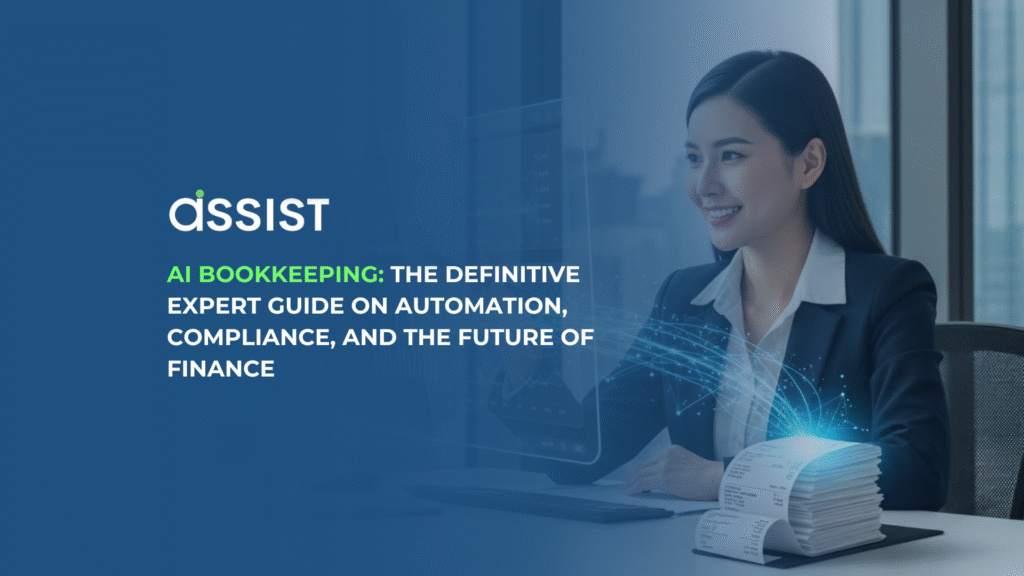

AI Bookkeeping is the use of machine learning and natural language processing to automate the entire lifecycle of financial data entry, categorization, and reporting, offering a significant upgrade in speed and accuracy over manual methods. This technology enables businesses to achieve real-time financial clarity, ensuring compliance and freeing up human talent for strategic analysis. By exploring this definitive guide, you will learn why this shift is essential for financial stability and how to successfully implement a high-quality AI solution.
The Unsolved Problem: Why Traditional Bookkeeping Fails Rapid Growth
As an expert voice in finance and technology, I can confidently tell you that bookkeeping, as we know it, is over. For businesses in a rapidly growing environment, where growth is explosive but compliance is complex, relying on manual processes is no longer sustainable. It is time to talk about the shift to AI bookkeeping: not just a software upgrade, but a strategic imperative that dictates the speed and accuracy of your financial future. The failure is not in the effort, but in the lack of speed, scale, and consistency required to manage cross-border transactions, multiple tax codes, and high-volume data. The traditional approach is simply too slow and error-prone to keep up with the demands of digital commerce and global reporting.
Defining AI Bookkeeping: More Than Just OCR
So, what is AI bookkeeping, truly? At its simplest, it is the application of machine learning (ML) and natural language processing (NLP) to automate the entire lifecycle of financial data entry and categorization. This is significantly more advanced than basic OCR (Optical Character Recognition), which merely extracts text from an image. AI bookkeeping systems use ML models to understand the context of an invoice, learn patterns in your spending, and intelligently categorize transactions with minimal human intervention. To get a comprehensive understanding of the technology behind the shift, you can review A comprehensive guide to OCR (Optical Character Recognition). If you are curious about the deeper implications, exploring how can bookkeeping AI change the way you do business offers a broader perspective on this transformation. The goal is automation, reliability, and the provision of real-time financial insights.
The ‘Before and After’: AI in Action (A Singaporean E-Commerce Example)
To grasp the impact, consider a mid-sized Singaporean e-commerce firm processing 500 invoices and receipts monthly.
Before AI: A bookkeeper spends 40 hours manually keying data, reconciling bank feeds, and chasing missing documents. Compliance checks for GST are manual, often leading to delays and potential penalties. Financial reports are generated weekly, meaning key business decisions are based on outdated data.
After AI: An AI system handles 95% of data entry and categorization in less than 5 hours. Automated document management stores all receipts safely. The bookkeeper shifts focus to complex reconciliation issues, strategic analysis, and ensuring accurate reporting. The result? A 70% reduction in processing time, improved accuracy, and real-time cash flow visibility, allowing the firm to focus on market expansion rather than administrative catch-up.
High Standards for Your Money: Why AI Bookkeeping is a YMYL Topic
Any discussion of financial technology must acknowledge the gravity of the topic. Bookkeeping is a YMYL (Your Money or Your Life) subject. This is not entertainment; it directly impacts the financial stability, safety, and legal standing of your business. Therefore, choosing and implementing an AI solution requires the highest level of Trust and Authoritativeness from both the solution provider and this guide.
A Compliance Comparison: Navigating Regulatory Landscapes
For businesses operating across borders, or simply preparing for international expansion, AI must be compliant everywhere. The specific needs of your primary audience are vastly different from those in the US market:
- Regional Compliance: This region is seeing a rapid shift toward government-mandated e-invoicing. For example, the upcoming e-invoice Malaysia 2025 mandate requires compliance with specific LHDN requirements, which AI solutions must automate flawlessly. Similarly, Singapore’s InvoiceNow network requires structured data exchange.
- US Compliance: The US market often grapples with complex, state-by-state sales tax rules, which require AI to accurately assign tax jurisdictions and calculate amounts across varying rates.
A robust AI solution must seamlessly adapt to both. If you are operating in Malaysia, a deep dive into everything you need to know on e-invoice Malaysia 2025 is essential. For general questions, you should also consult the FAQ on compliance.
Trust & Security: Data Privacy in a Cross-Border AI System
Handling sensitive financial data across different jurisdictions introduces immediate Trust concerns. For an AI bookkeeping solution to be reliable, it must prioritize data privacy and security. Raters assess content based on whether it is safe, and we agree: financial data security is non-negotiable.
Your chosen system must adhere to global best practices for data handling, focusing on encryption, access controls, and transparent data usage policies, such as those detailed in our privacy policy. Furthermore, the move towards AI should be guided by a human-centered AI for SMEs philosophy, ensuring the technology serves and empowers, rather than replaces, the decision-making authority of the user.
Your AI Bookkeeping Implementation Roadmap: A Tool-Agnostic Approach
Adopting AI bookkeeping should be a strategic process, not a rushed one. To ensure success and mitigate risk, here is a platform-independent roadmap that applies whether you use QuickBooks, Xero, or a localized tool.
The 5-Step Implementation Roadmap (Prep to Go-Live)
- Preparation & Audit: Analyze your existing data quality and financial workflows. Identify bottlenecks (e.g., invoice approval, receipt storage).
- Tool Selection & Integration: Choose a solution that specifically supports your local compliance needs and integrates with your existing financial tools. Look into how our platform facilitates integration with Xero or handles data flow with integration with Quickbooks.
- Initial Data Migration & Training: Feed the AI historical data to train its machine learning model. This is where the AI learns your unique categorization patterns, ensuring higher accuracy post-launch.
- Parallel Run & Oversight: Run the AI system alongside your traditional bookkeeping for a defined period (e.g., one month). This allows your team to gain crucial first-hand experience and verify accuracy.
- Full Go-Live & Review: Transition fully to the AI system. Establish a continuous review process to measure key performance indicators (KPIs) and address any edge cases the AI may struggle with.
Key Decisions: Fully Automated vs. Hybrid (AI + Human Oversight)
A common misconception is that AI eliminates the need for human input. The most effective systems, however, are hybrid models—combining AI’s speed with human intelligence’s oversight.
| Model | Pros | Cons |
| Fully Automated | Fastest processing, lowest cost potential. | Limited handling of complex or novel transactions; high risk of non-compliance without human review. |
| Hybrid (AI + Human) | High accuracy, AI handles repetitive tasks, human focuses on strategic analysis and edge cases. | Slightly higher labor cost; requires human training and experience with the system. |
For YMYL tasks like bookkeeping, the hybrid model, as championed by solutions like Assist AI Bookkeeping, offers the ideal balance of speed, accuracy, and compliance assurance.
The Essential Feature Checklist: What to Look for in a Solution
When evaluating partners, shift your focus from marketing hype to demonstrable features that directly impact the quality and compliance of your finances. This checklist aligns with the Needs Met requirement for a comprehensive tool comparison:
- Multicurrency & Localization: Does the solution handle cross-border payments in multiple currencies accurately, a fundamental requirement for global firms?
- Compliance Automation: Can it automate the creation of tax-compliant documents or integrate with government e-invoicing portals?
- High-Quality Extraction: Does it use advanced AI (not just template-based OCR) to achieve high accuracy in data extraction? Review the features and benefits page of any solution to ensure it meets these high standards.
E-E-A-T in Practice: Vetting Your AI Bookkeeping Partner
To demonstrate true authority on this YMYL topic, we must explicitly show how to vet a solution based on E-E-A-T: Experience, Expertise, Authoritativeness, and Trust.
The Expert Voice: Why First-Hand Experience Matters
When evaluating a solution, look for proof of Experience from those who actually use it. This includes the first-hand use of the system by bookkeepers who rely on it for daily efficiency and the strategic results achieved by business owners. You should be able to see case study evidence of the tool’s effectiveness, proving that the software works in real-world, high-stakes environments.
Beyond the Hype: Misconceptions and Limitations of AI Bookkeeping
True Expertise is not just knowing what AI can do, but what it cannot do. We must dispel the hype:
- Misconception: AI can replace your accountant entirely.
- Reality: AI is a powerful tool for automation, but it lacks the strategic context for high-level tax planning, complex business consulting, or discretionary approvals—areas where human oversight remains essential. A healthy system knows its limitations.
Acknowledging these boundaries enhances Trust and demonstrates the maturity of the expert voice.
The Gold Standard: How to Measure AI Accuracy and Reliability
For any financial tool, Trust boils down to accuracy. High-quality AI platforms must disclose and demonstrate their performance, setting the gold standard for the industry.
We need to measure key metrics like:
- Categorization Accuracy Rate: How often does the AI correctly categorize a transaction autonomously?
- Processing Time: How quickly is a document processed from upload to ready-to-export?
Seek out vendors who can prove their Authoritativeness through third-party audits or industry certifications, similar to the information available on the about us/certifications page.
Conclusion: Your Next Step to Financial Clarity
The transition to AI bookkeeping is inevitable for businesses seeking growth, compliance, and efficiency. By prioritizing solutions that demonstrate high E-E-A-T standards, offer regulatory flexibility, and support a hybrid model of automation and human oversight, you ensure your finance function becomes a competitive advantage, not a liability. We have shown how AI delivers speed, accuracy, and the peace of mind required to operate in the dynamic, high-stakes environment of global commerce.
Now is the time to put this knowledge into practice. To explore a solution engineered specifically for the complexities of the market, one that integrates with Xero and QuickBooks while delivering the highest standards of automation, consider Assist service bookkeeping AI. You can see exactly how it works with a demonstration or a guided tour. Ready to transform your finance workflow and try it out? Register for using Assist solution and try it for free today at https://app.assist.biz/auth/register.