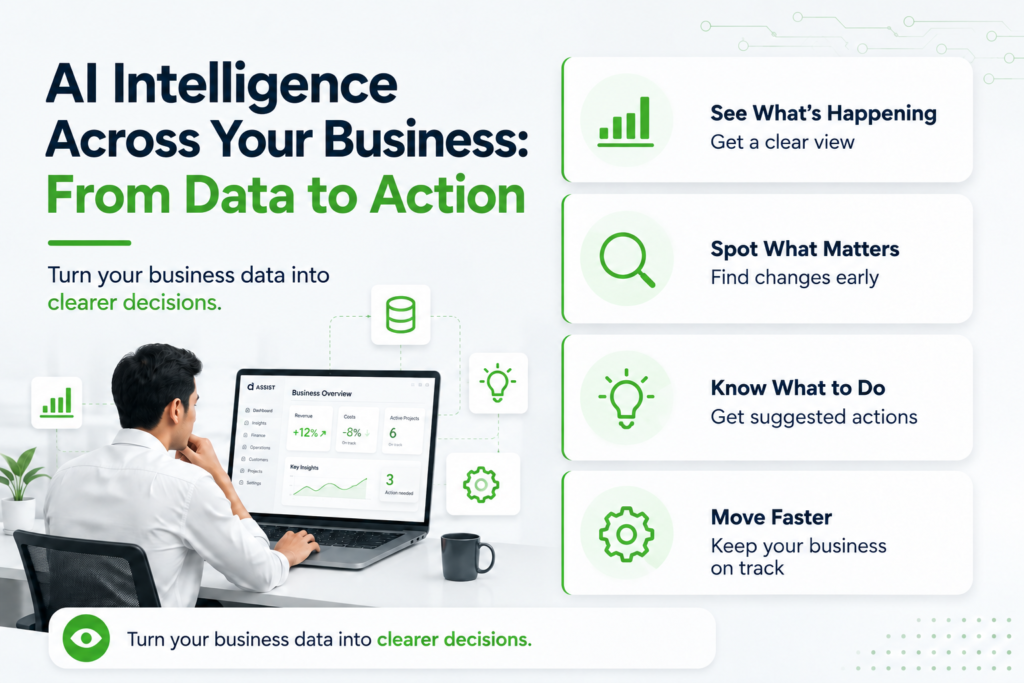






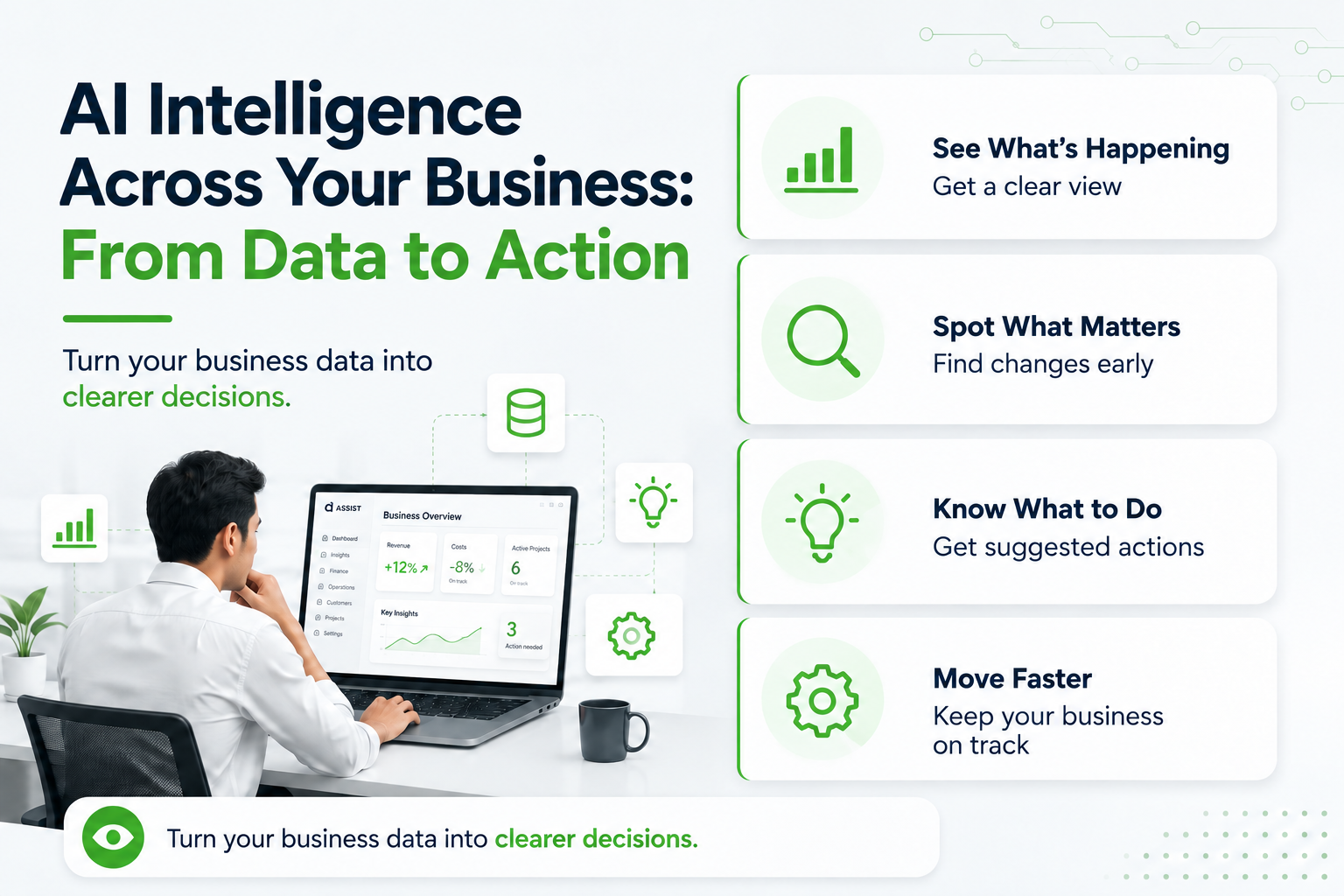

AI intelligence across the entire business means connecting AI with company data, systems and workflows so useful intelligence can move between departments. Instead of isolated AI tools handling individual tasks, enterprise-wide AI helps finance, sales, operations, customer service and leadership understand what is happening, identify exceptions and coordinate the right response.
Many businesses across Singapore, Malaysia and the wider APAC region already have plenty of data. It sits in ERP systems, databases, accounting platforms, documents, dashboards, approval workflows and business applications.
The harder problem is turning that information into something management can act on while there is still time to make a difference.
A report may eventually show that costs increased, a customer stopped ordering or a project margin fell below target. By the time information has passed through data entry, reconciliation, reporting and management review, the underlying problem may have existed for weeks.
Enterprise-wide AI changes the question from “What happened?” to “What is happening now, why does it matter, and what should happen next?”
What AI intelligence across the entire business actually means
Enterprise AI intelligence is the ability to use AI with connected organisational data, systems and workflows across multiple business functions.
Giving employees access to AI assistants is useful, but that alone does not create an intelligent business.
An employee might use AI to summarise a report in seconds. Unless the relevant insight reaches another authorised workflow, system or decision-maker, the intelligence stops with that employee.
Enterprise intelligence connects information to business context. A change in customer activity might matter to sales, finance, operations and management at the same time. Each function needs a different part of the story.
This is where many AI projects become harder than the initial pilot. The AI model may work. The surrounding business still has disconnected databases, inconsistent records, manual handoffs and unclear permissions.
Active intelligence goes beyond traditional business intelligence
Traditional business intelligence is usually strongest at explaining the past. Dashboards tell management what happened, how much was spent and what the final result was.
Those answers remain useful. They support financial review, performance analysis and planning.
Active intelligence is a model in which business data is continuously interpreted against current conditions, expected patterns and defined rules so the organisation can identify important changes and decide what to do next.
That changes the role of business intelligence.
Instead of waiting for someone to inspect a dashboard, an intelligent system can monitor agreed conditions and bring meaningful exceptions to the appropriate person. It might detect that a regular customer has stopped ordering, an expected invoice is missing, supplier costs have moved outside their usual range or an approval is taking much longer than normal.
The objective is earlier visibility. Management should not have to search through every report to discover which issue deserves attention.
How intelligence moves across a connected business
A cross-functional AI workflow is a process where information, AI-generated insight or approved actions can move between departments and systems rather than remaining inside one application or team.
A practical model looks like this:
Business data → connected systems → AI intelligence → monitoring and detection → decisions and actions → human oversight → business outcomes
Consider an APAC distributor whose major customer suddenly reduces an order.
Sales records the change in its CRM. That new demand signal matters to inventory because stock may already be inbound. Operations may need to adjust capacity. Finance may need to revise expected cash flow. Management needs to know whether the change is isolated or part of a wider pattern.
In a disconnected organisation, employees discover those effects through spreadsheets, messages, meetings and periodic reports.
With connected intelligence, authorised systems can pass the relevant context through defined workflows. AI can analyse the change, compare it with historical patterns, identify the likely business impact and alert the people responsible.
The goal is not to let AI run the company. It is to shorten the distance between an important business event and an informed response.
AI tools, automation and enterprise intelligence solve different problems
These technologies overlap, but they should not be treated as interchangeable.
| Capability | Individual AI tool | Workflow automation | Enterprise AI intelligence |
| Primary scope | Individual task | Defined process | Cross-functional workflows |
| Data context | Usually limited | Structured inputs | Connected business context |
| Cross-system operation | Sometimes | When integrated | Core requirement |
| Generates explanations | Usually | Not necessarily | Yes |
| Monitors changing conditions | Limited | Rule-based | Rules, patterns and context |
| Detects anomalies | Sometimes | Defined exceptions | Can compare against business baselines |
| Can trigger actions | Sometimes | Yes | Potentially |
| Human oversight | User-driven | Rule or exception-driven | Based on risk and authority |
Traditional automation is still the better answer for many predictable processes. If an approved field needs to move from one system to another under a fixed rule, conventional automation may be cheaper and easier to control.
AI earns its place when the task involves unstructured information, interpretation, changing patterns or decisions that cannot be captured cleanly by a fixed rule.
A connected enterprise can use both.
What enterprise AI looks like across business functions
Enterprise AI becomes easier to understand when you stop thinking about departments as isolated boxes.
In finance, intelligence can monitor cash position, revenue, expenses, receivables, payables, margins and recurring costs. AI can also help identify missing revenue or unusual spending patterns. Businesses exploring this area can read more about how AI is changing accounting workflows.
In operations, the same approach can monitor process delays, service performance, missing documents and resource utilisation. A recurring process that suddenly does not occur can be treated as an exception rather than waiting for someone to notice it manually.
In project management, intelligence can compare costs, margins, milestones and resource use against expected patterns. A cost increase becomes more useful when management can also see what caused it and whether the project margin is at risk.
In customer management, changes in ordering patterns, payment behaviour or service activity can become early signals. A customer who normally orders every month but suddenly stops may deserve attention before the change appears in a quarterly revenue report.
The same principle applies to policies and contracts. Systems can monitor approval thresholds, contract dates and defined business rules, then flag exceptions for review.
For smaller companies, connected intelligence does not require an enterprise-scale transformation on day one. AI-powered small-business tools show how organisations can start with narrower operational processes.
Business baselines help AI identify what deserves attention
Detecting a change requires some idea of what “normal” looks like.
A business baseline is a reference pattern built from relevant historical activity, operational rules or expected performance against which current activity can be compared.
That baseline might include customer revenue patterns, supplier expenses, transaction volumes, processing times, project margins, contract periods or department KPIs.
Suppose a customer normally generates revenue every month. The absence of an expected transaction can itself become information. A monitoring system can identify the missing activity, assess its potential impact and bring it to the responsible team.
The same logic works for costs. A supplier charge that continues after a contract end date may deserve investigation. A project whose contractor expenses rise while milestones slip may need attention before month-end reporting.
Not every deviation is a problem. The system still needs business context, thresholds and human judgement to distinguish a meaningful exception from normal variation.
What infrastructure does enterprise-wide AI need?
Enterprise AI does not begin with choosing the biggest model. It begins with the information and processes the business already relies on.
Five foundations matter:
- Reliable business data that provides enough context for the intended use case.
- Connected systems and APIs that give authorised information a controlled path between applications.
- Appropriate AI models and retrieval methods for the task.
- Identity, permissions and security that control what information and actions are available.
- Workflow orchestration and monitoring that record what happened and determine when a person should intervene.
The technical objective is not to connect everything indiscriminately. More access without adequate control creates a larger risk surface.
Businesses do not need all their data in one database
A company can build useful enterprise AI without moving every record into a single central database.
A CRM can remain the customer system of record. Accounting software can remain responsible for financial records. Documents can stay in the appropriate document platform. Integration determines which authorised information crosses those boundaries.
This principle is already visible in narrower workflows such as integrating business processes with Xero and QuickBooks.
Retrieval-Augmented Generation (RAG) is a method that allows an AI application to retrieve relevant external information when producing an answer. Within a business, this can allow an authorised application to use current policies, product information or internal documentation rather than relying only on a model’s training data.
AI agents can divide intelligence work into specialised roles
An AI agent is software that can interpret a goal, determine appropriate steps and interact with permitted tools or systems within defined controls.
An enterprise does not necessarily need one AI system trying to do everything. Different agents can perform specialised tasks.
A data-oriented agent might interpret documents and system information. A rule agent can check policies and approval conditions. A monitoring agent watches current business activity, while an anomaly agent looks for unusual or missing events.
An advisory agent can then explain why an exception matters and suggest a response. An action agent may trigger an alert, approval or follow-up when its permissions allow it.
That creates a practical autonomy ladder:
- AI understands the information.
- AI detects an issue.
- AI explains the business impact.
- AI recommends an action.
- A person reviews the recommendation where required.
- AI executes an approved or pre-authorised workflow.
Not every process needs the final step. Agentic AI for smaller businesses explores the same question at a different organisational scale: what should software be allowed to do, and what should remain a human decision?
Human oversight matters more when AI can act
Human-in-the-loop governance is an operating model in which specified AI outputs or actions require human review, approval, escalation or intervention.
An AI assistant reading one document has a limited operating surface. A system connected to financial information, customer records and operational applications can be much more useful, but an incorrect action can also travel further.
Permissions need to follow both the user’s role and the sensitivity of the action.
An AI system that reads an invoice does not automatically need authority to approve payment. An agent that prepares a customer response does not necessarily need permission to send it.
Auditability matters too. Organisations need to know what information was used, what exception was detected, what action was recommended and who approved the next step.
Singapore and Malaysia businesses should start with a measurable workflow
Singapore and Malaysia should not be treated as one AI market simply because both sit within Southeast Asia. Their digital environments, government programmes and organisational readiness differ.
For Singapore businesses, AI readiness increasingly involves strategy, workforce capability, data governance, integration and measurable business value. A practical starting point is a process where several systems or teams already exchange information. Mapping those handoffs exposes poor data, duplicate work and approval bottlenecks before AI is added.
Malaysian businesses face similar architectural questions, but starting points can vary considerably between larger enterprises and SMEs that still depend on spreadsheets, email and manual document processing.
A complete technology overhaul is not a prerequisite. One measurable workflow can be enough to begin. The approach described in digital transformation for SMEs through invoicing automation is an example of using a specific operational process as the entry point.
For either market, “Are we ready for AI?” is too broad to be useful. Ask which process has reliable enough data, sufficient business value and clear enough governance to connect first.
Measure business outcomes, not the number of AI tools
Counting AI subscriptions tells management little about whether AI is improving the business.
Establish a baseline for the workflow before changing it, then track measures such as:
- cycle time
- error and exception rates
- employee intervention
- cost per transaction
- decision latency
- customer response time
- revenue leakage identified
- unnecessary costs detected
- attributable margin or revenue effects
The metric should match the problem.
A finance workflow might measure processing time, overdue receivables or exceptions. Customer service may focus on response and resolution. Project intelligence may monitor margin changes, delays and resource use.
This also creates a feedback loop. If the system generates dozens of alerts that employees routinely ignore, the monitoring logic needs work. Intelligence is useful when it changes a decision or action at the right time.
Frequently asked questions
What does AI intelligence across the entire business mean?
In practice, it means an insight surfaced in one department can reach the people in another department who need it, instead of stopping with whoever ran the AI query. Finance, operations and customer teams end up working from the same connected picture rather than separate reports.
How is enterprise AI different from using ChatGPT or other AI tools?
An individual AI tool typically helps a person complete a specific task. Enterprise AI connects AI capabilities to authorised business systems, data and workflows so the output can contribute to a wider operational process.
Which business functions should companies connect to AI first?
Companies should start with a process that has clear business value, usable data and measurable outcomes. High-volume workflows with repetitive work, detectable exceptions and defined approval responsibilities often provide a more manageable starting point than connecting every department at once.
Does a business need all its data in one system before using enterprise AI?
No. Enterprise AI can work across separate systems through APIs, integration layers and controlled retrieval. The requirement is reliable access to the right information with appropriate permissions, not one database containing every business record.
What is the difference between enterprise AI and workflow automation?
Workflow automation executes predefined processes and rules. Enterprise AI can interpret less structured information, detect patterns, generate explanations and support decisions using context. Many useful enterprise workflows combine conventional automation with AI.
What role do AI agents play in enterprise AI?
Agents divide the work by specialisation rather than one system trying to do everything, and each earns autonomy in stages: understanding and flagging first, acting only once permissions and the task’s risk level allow it.
How can AI detect business problems earlier?
AI can compare current business activity with historical baselines, expected patterns, policies and thresholds. It can then flag meaningful exceptions such as missing transactions, unusual expenses, delayed approvals or changes in customer behaviour for review.
What are the main risks of connecting AI across a business?
The main risks include inappropriate data access, inaccurate outputs, excessive permissions, poorly controlled automated actions and unclear accountability. As more systems become connected, access control, monitoring, audit trails and human approval become more important.
How can Singapore and Malaysia businesses prepare for enterprise-wide AI?
Businesses in Singapore and Malaysia can begin by mapping one valuable workflow, identifying the systems and data it depends on, defining normal business patterns, setting measurable outcomes and deciding where human approval is required before expanding AI into other functions.
Turn business information into intelligence that arrives in time
AI intelligence across the entire business becomes valuable when it helps people know earlier, act faster and make better-informed decisions. That is the model behind ASSIST Intelligence: an AI-powered intelligence layer designed to complement existing systems, documents and workflows rather than replace them, with capabilities spanning real-time visibility, proactive alerts, risk and anomaly detection, business explanations, recommended actions and workflow automation. Organisations exploring where that model could fit can talk to an infrastructure specialist about AI readiness and identify a practical first workflow to connect.