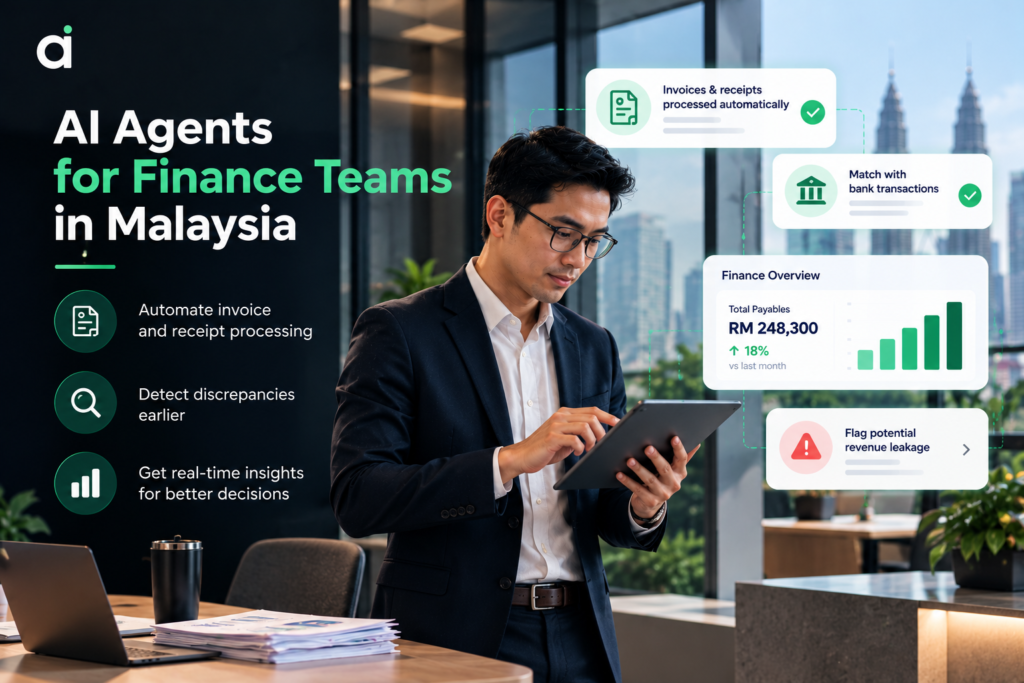





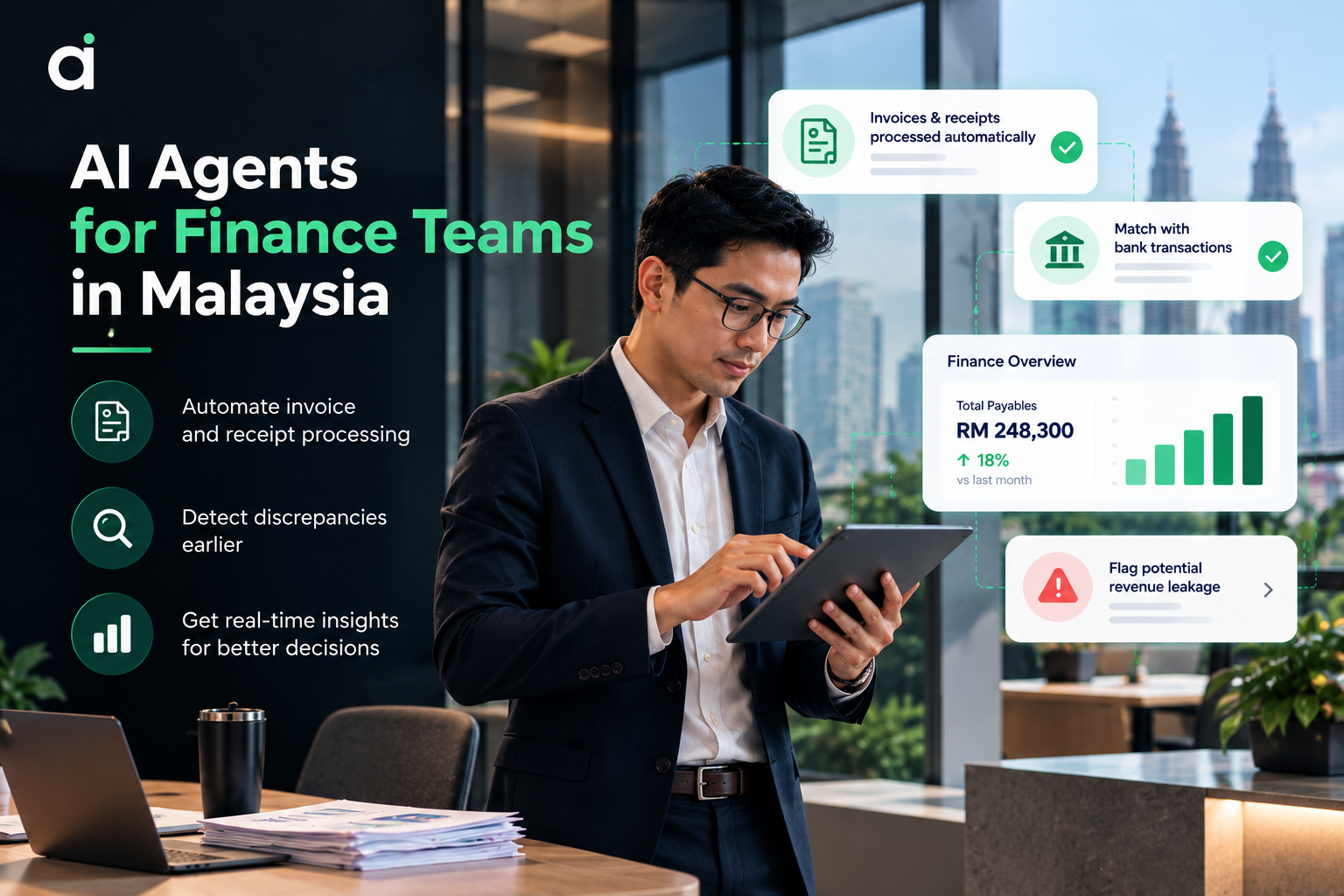

Finance teams are no longer expected to simply process transactions and prepare reports. Today, they must identify financial risks earlier, improve cash flow visibility, maintain accurate records, and provide insights that support business decisions.
For large Malaysian enterprises, these responsibilities become increasingly complex. A manufacturing group may process thousands of supplier invoices across multiple subsidiaries, while a regional shared services centre may manage financial operations across different countries, currencies, and accounting systems.
Traditional automation has helped reduce repetitive work, but many processes still require manual investigation when unexpected issues arise.
This is where AI agents for finance teams are beginning to change how businesses approach financial operations.
Unlike conventional automation, AI agents can interpret information, investigate discrepancies, coordinate workflows, and perform authorised actions across connected systems.
However, greater autonomy also introduces new concerns about financial accuracy, security, and accountability.
Singapore’s Monetary Authority of Singapore (MAS) has recently strengthened its approach to AI risk management, offering valuable lessons for enterprises across the Asia-Pacific region.
For Malaysian finance leaders, the question is no longer just whether AI can improve finance operations. It is how organisations can use AI agents effectively while maintaining control over critical financial decisions.
What Are AI Agents in Finance?
AI agents are AI-powered systems designed to complete defined objectives by analysing information, determining appropriate next steps, and interacting with authorised business applications.
In finance, this means moving beyond basic data extraction or rule-based automation.
Imagine a supplier invoice that does not match its purchase order.
A traditional automation system might flag the discrepancy and wait for someone to investigate. An AI agent, with appropriate system access, could retrieve the purchase order, compare the amounts, review supporting documents, and prepare an explanation for the finance team.
The difference is not simply faster processing. It is the ability to coordinate several steps within a financial workflow.
AI Agents vs Traditional Finance Automation
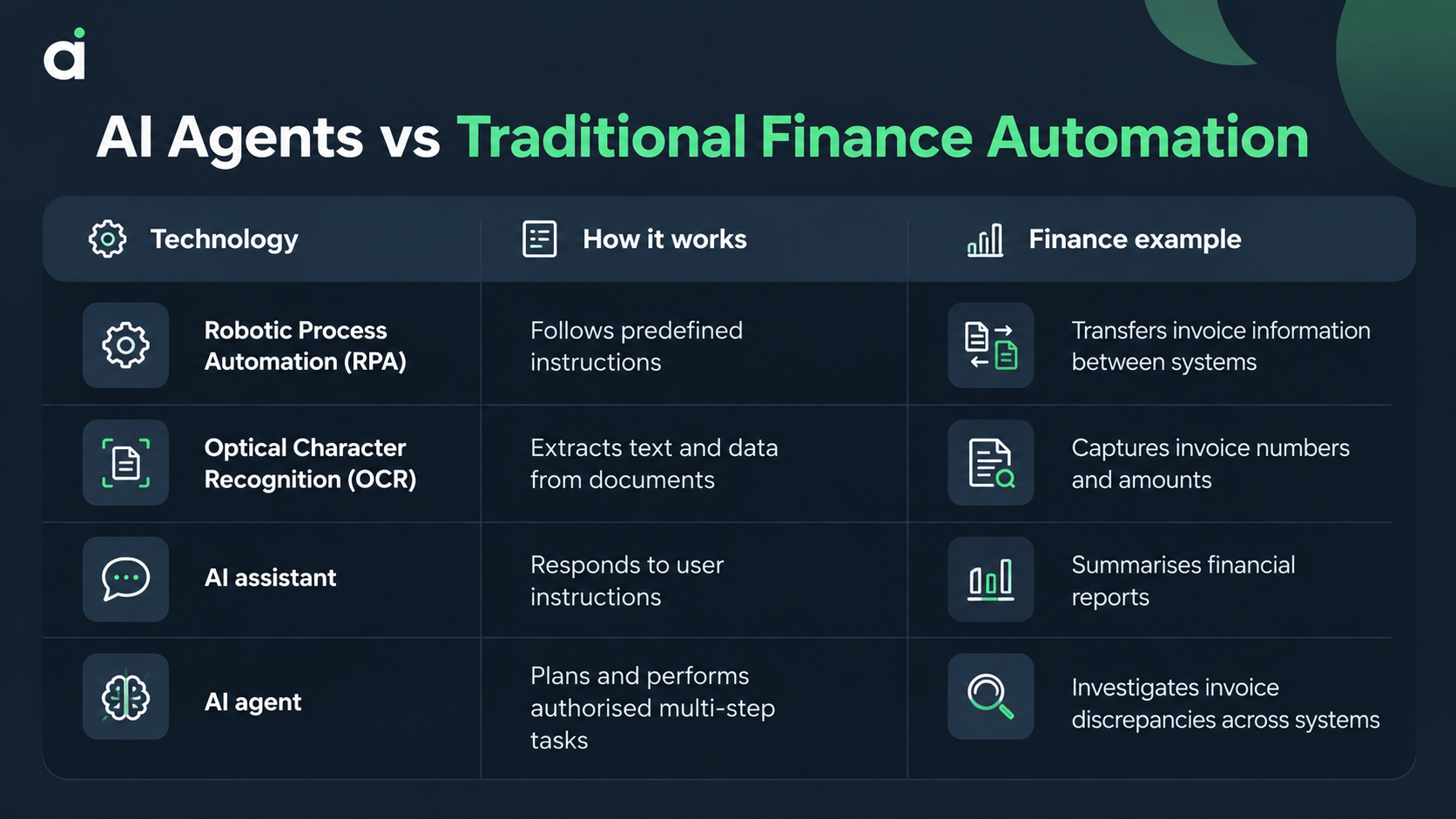
These technologies can work together. An AI agent may use OCR to read documents, RPA to interact with legacy applications, and AI models to interpret financial information.
This evolution builds on the wider adoption of AI-powered accounting and financial automation, where businesses increasingly use technology to reduce manual work and improve financial visibility.
Still, not every AI-enabled finance application qualifies as an autonomous agent. Businesses should evaluate what a system can actually do before relying on it for critical financial activities.
Six Core Capabilities of AI Agents for Finance Teams
AI agents can support different areas of enterprise finance, depending on their design, integrations, and permissions.
- Financial Document Interpretation
AI agents can use document-processing technology to interpret invoices, receipts, contracts, and financial statements.
Beyond extracting information, they may compare document details against existing accounting records to identify missing or inconsistent information.
- Financial Reasoning and Analysis
Agents can investigate unusual transactions, compare financial information, and prepare explanations for discrepancies.
For example, an agent could examine why operating expenses increased across several subsidiaries and identify transactions requiring further review.
- Multi-Step Workflow Planning
Rather than following a single predefined instruction, an AI agent can determine the sequence of tasks needed to achieve a specific objective.
When investigating an overdue invoice, it might check payment records, review customer correspondence, and prepare a recommended follow-up.
- Enterprise System Coordination
Large enterprises often operate multiple ERP, accounting, and reporting systems.
AI agents can interact with these applications through authorised integrations, helping finance teams retrieve and compare information without repeatedly switching platforms.
- Continuous Financial Monitoring
AI agents can monitor financial information for unusual patterns, missing transactions, and emerging risks.
This could help finance teams identify overdue receivables, unexpected cost increases, or billing discrepancies before month-end reporting.
- Authorised Task Execution
Some AI agents can update records, route approvals, or initiate permitted workflows.
However, the ability to perform a financial action does not automatically mean an agent should be authorised to execute it.
Payment approvals, supplier banking changes, and material accounting adjustments require appropriate controls and human oversight.
Seven Practical AI Agent Use Cases for Large Enterprises
For Malaysian enterprises managing high transaction volumes and multiple business entities, AI agents offer opportunities to improve financial efficiency and decision-making.
- Accounts Payable and Invoice Exception Management
Large organisations often receive thousands of invoices from suppliers with different payment terms, purchase orders, and supporting documents.
AI agents could compare invoice information against purchase orders and goods-received records, identify mismatches, and prepare recommendations for finance reviewers.
This extends established controls such as three-way matching in accounts payable, where invoice details are checked against purchase orders and goods receipts before payment.
- Accounts Receivable and Collection Monitoring
Managing outstanding receivables becomes more challenging when enterprises deal with numerous customers and different payment arrangements.
AI agents could monitor overdue balances, review payment histories, and identify accounts requiring attention.
They may also help distinguish routine late payments from invoices affected by disputes, allowing finance teams to prioritise appropriate follow-ups.
- Bank Reconciliation and Transaction Matching
Enterprises operating multiple bank accounts frequently encounter unmatched transactions, inconsistent payment references, and timing differences.
AI agents could investigate these discrepancies by comparing bank statements, accounting records, and supporting documents.
Finance professionals would then focus on unresolved exceptions rather than manually checking every transaction.
- Revenue Leakage and Billing Error Detection
Revenue leakage can occur when services are delivered but not billed, contract rates are applied incorrectly, or approved charges are omitted.
For example, a Malaysian logistics company may manage customer agreements with different freight rates and surcharges.
An AI agent could compare delivery records, contract terms, and issued invoices to identify potential underbilling.
- Financial Reporting and Variance Analysis
Preparing consolidated reports across subsidiaries often requires collecting data from multiple systems and explaining unusual financial movements.
AI agents could identify significant variances, retrieve supporting transactions, and draft preliminary management commentary.
Financial controllers would still need to validate the findings before finalising reports.
- Cash Flow and Working Capital Monitoring
AI agents could monitor outstanding receivables, upcoming supplier payments, and changes in customer payment behaviour.
This may help treasury teams recognise potential liquidity pressures earlier and make more informed working capital decisions.
- Audit Preparation and Evidence Collection
Audit preparation often involves gathering invoices, approval records, payment documents, and transaction histories.
AI agents could locate relevant supporting information, organise audit evidence, and flag missing documentation.
For organisations already adopting AI bookkeeping and automated financial record management, these capabilities could support more consistent financial documentation and audit readiness.
What Singapore’s MAS AI Safeguards Mean for Malaysian Enterprises
As AI agents become capable of performing more complex financial tasks, regulators are paying closer attention to how organisations manage AI-related risks.
Singapore’s Monetary Authority of Singapore (MAS) provides an important regional example.
MAS AI Risk Management Guidelines: October 2026
On 7 October 2026, MAS issued its final Guidelines on Artificial Intelligence Risk Management for Financial Institutions.
The guidelines establish supervisory expectations covering AI governance, risk assessment, lifecycle controls, human oversight, and third-party AI services.
They apply to MAS-regulated financial institutions and all forms of AI, including agentic AI.
Implementation is phased:
- 7 October 2027: Sections 3 and 4 take effect, covering governance and AI risk management expectations.
- 7 October 2028: Financial institutions should meet the expectations in Sections 5 and 6, including lifecycle controls and organisational capabilities.
MAS also adopts a risk-proportionate approach, meaning organisations should apply controls according to the nature and potential impact of their AI use.
For enterprise finance leaders, the broader lesson is that an agent preparing a draft report should not necessarily have the same permissions as one involved in payment execution.
What Is SAFR, and Why Does It Matter?
MAS has also worked with industry participants on the Safeguards for Agentic Finance at Runtime (SAFR) framework.
Unlike general AI governance principles, SAFR focuses on controlling what AI agents are permitted to do when executing financial tasks.
In October 2026, MAS highlighted SAFR version 1.1 and an open-source reference implementation supporting further industry experimentation.
The framework centres on three safeguards:
Agent identity and authorisation: Organisations should know which agent is performing an action and what authority it holds.
Mandate verification: Proposed actions should be checked against the user’s instructions and authorised limits before execution.
Accountability and auditability: Agent activities should be recorded so organisations can trace decisions and investigate issues.
Consider an AI agent preparing a supplier payment batch. It may be authorised to validate invoice information and prepare payment instructions, but payments above a defined threshold could require human approval.
SAFR provides a useful model for designing such controls. However, it is an evolving industry framework, not a standalone mandatory regulation for Malaysian businesses.
Do MAS Guidelines Apply to Malaysian Companies?
MAS guidelines do not automatically apply to Malaysian manufacturing companies, retailers, logistics providers, or other non-financial enterprises.
However, Malaysian organisations operating Singapore-regulated financial entities should assess whether the guidelines apply to those entities.
For other Malaysian enterprises, the MAS approach offers a useful governance benchmark.
The principle is straightforward: AI agents should operate within clearly defined permissions, regardless of how advanced their capabilities become.
Malaysia’s AI Governance and Data Protection Landscape
Malaysian enterprises should also consider domestic governance principles when introducing AI agents into financial operations.
Malaysia’s National Guidelines on AI Governance and Ethics (AIGE) provide principles for responsible AI adoption, including privacy, security, transparency, and accountability.
The National AI Office’s voluntary AI Code of Ethics also supports organisations in translating these principles into practical implementation.
Bank Negara Malaysia has examined AI adoption and risk management within the financial sector, including through its August 2025 AI discussion paper. Enterprises should distinguish policy discussion from requirements that are legally applicable to their activities.
Data protection is equally important.
Finance systems may contain employee expense records, customer information, supplier contact details, and confidential business data.
Where Malaysia’s Personal Data Protection Act applies, organisations must consider relevant obligations involving personal data processing, security, and disclosure.
For multinational enterprises, cross-border data transfers and third-party AI providers may introduce additional compliance considerations.
Five Risks Finance Leaders Should Address Before Deploying AI Agents
AI agents offer opportunities to improve finance operations, but they also introduce risks that require careful management.
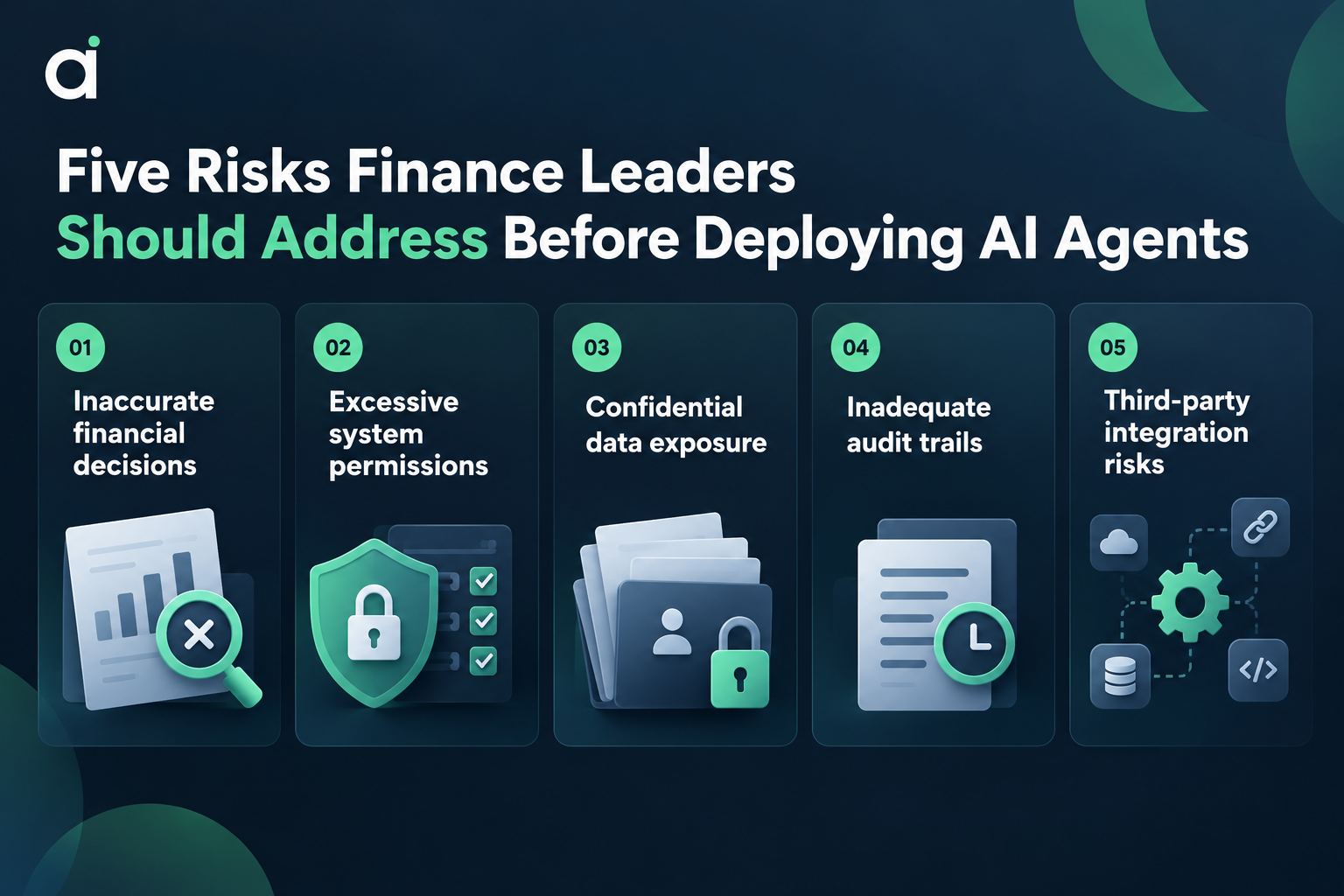
These risks highlight why human oversight, ongoing monitoring, and clearly assigned accountability remain important even as automation becomes more sophisticated.
How to Implement AI Agents in Enterprise Finance
Successful AI adoption begins with selecting the right business problem, rather than introducing the most advanced technology available.
For Malaysian enterprises, a phased approach can help balance efficiency with financial control.
Step 1: Identify Suitable Finance Processes
Start with repetitive, measurable activities that have manageable financial consequences.
Invoice exception investigation, reconciliation support, and preliminary financial reporting are practical starting points.
Step 2: Assess Data and Integration Readiness
AI agents rely on accessible and accurate information.
Evaluate ERP integration capabilities, data quality, document consistency, and access permissions before implementation.
Step 3: Establish Governance and Approval Controls
Define which tasks an agent can perform independently, which require human approval, and which actions must remain restricted.
Include escalation procedures, audit logging, and mechanisms to suspend agent activity when necessary.
Step 4: Run a Controlled Pilot
Test AI agents using historical transactions, realistic exceptions, and carefully selected workflows.
Measure accuracy, false positives, processing efficiency, and compliance with established controls.
Step 5: Measure Results Before Scaling
Finance leaders should evaluate outcomes beyond processing speed.
Useful indicators include exception resolution accuracy, manual intervention rates, financial close time, operational costs, and unauthorised actions prevented.
For example, a hypothetical Malaysian manufacturing group processing 50,000 invoices monthly could begin by testing an AI agent on invoice discrepancies within one subsidiary.
Only after validating its accuracy, controls, and measurable benefits should the organisation consider expanding deployment across additional entities.
Frequently Asked Questions About AI Agents in Finance
Can AI agents approve supplier payments?
Technically yes, but accountability for the payment stays with the business, not the agent, so release authority is usually kept with a named approver under existing segregation-of-duties rules.
Why would a non-financial Malaysian company look at MAS AI guidance?
There is no obligation to, but SAFR’s model of agent identity, mandate checks, and audit logs gives any finance team a ready-made checklist for setting agent permissions.
Do AI agents replace existing RPA bots?
Usually not. Stable, rule-based tasks often stay on RPA, while agents handle the exceptions those bots cannot resolve on their own.
How can you tell a finance process is ready for an AI agent?
Look for digital, consistent inputs, errors that can be caught before money moves, and a manual workload you can measure today for a before-and-after comparison.
Conclusion: Building a More Intelligent and Accountable Finance Function
AI agents are changing how enterprise finance teams investigate financial issues, coordinate workflows, and support business decisions.
Their value extends beyond faster processing. They can help organisations identify discrepancies earlier, improve financial visibility, and reduce repetitive investigation work.
However, successful adoption depends on maintaining financial accuracy, security, and accountability. Singapore’s MAS guidelines and SAFR framework reinforce the importance of risk-based governance, while Malaysia’s own AI and data protection landscape provides additional considerations for local enterprises.
For organisations looking to strengthen their finance operations, ASSIST’s finance automation solutions provide a starting point for improving document processing, invoice management, and financial workflows.
When you are ready to see how AI agents could fit into your own finance processes, create an ASSIST account to get started.