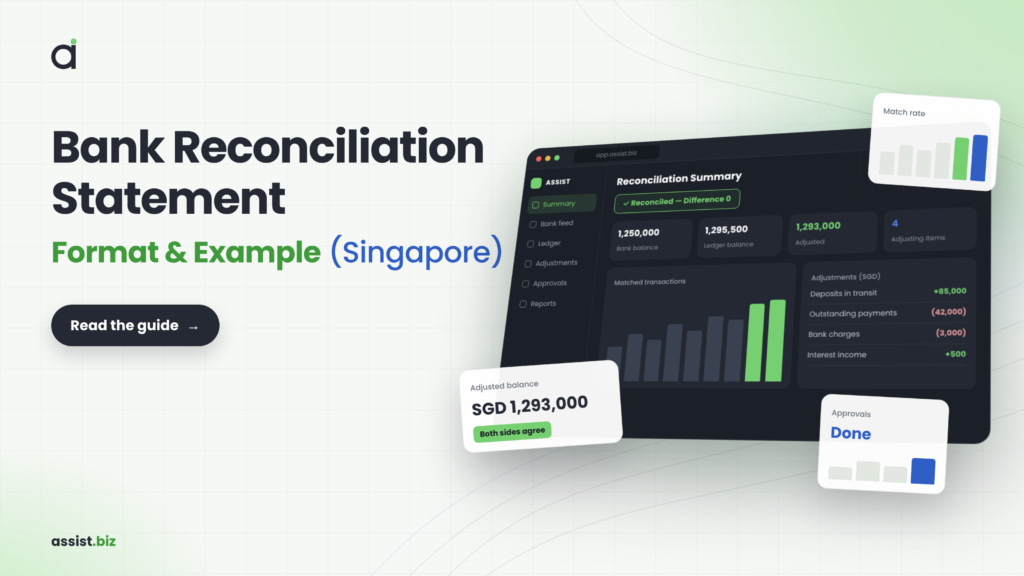






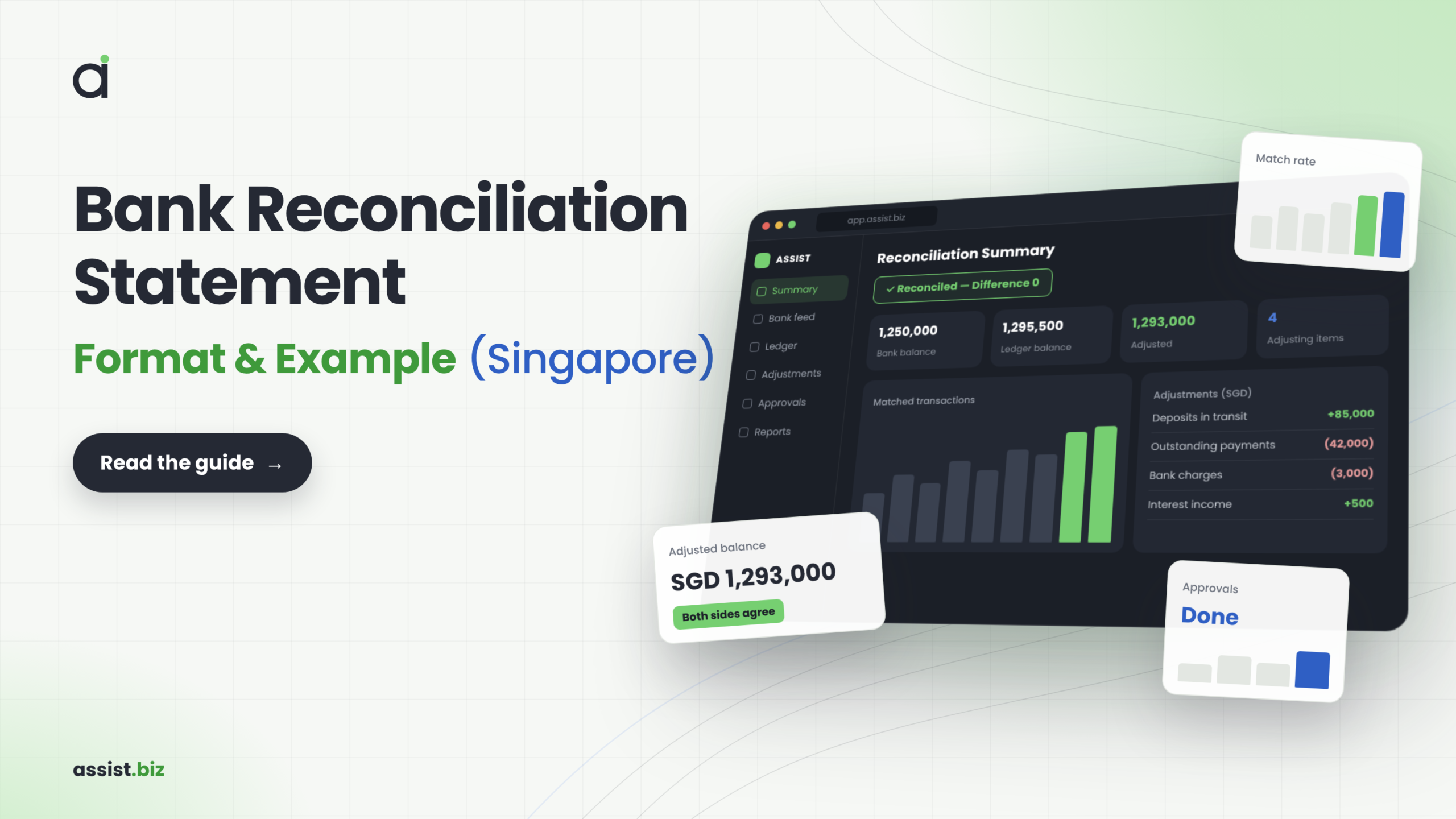

A bank reconciliation statement is an accounting document that compares a company’s bank statement balance with its recorded cash balance. It explains differences caused by outstanding payments, deposits in transit, bank charges and accounting errors, helping finance teams establish an accurate cash balance for financial reporting, internal controls and audit purposes.
For Singapore companies managing multiple bank accounts, thousands of transactions and regional subsidiaries, reconciliation can be a demanding part of the month-end close. As businesses adopt digital accounting and financial document management solutions, maintaining consistent records across banking and accounting systems becomes increasingly important. A difference between balances does not necessarily indicate an error. What matters is whether your finance team can explain, document and resolve it.
What is a bank reconciliation statement and why does it matter?
A bank reconciliation statement (BRS) identifies and explains differences between the cash balance reported by a bank and the balance maintained in a company’s accounting system.
Banks and businesses may record transactions at different times. Other discrepancies arise from unrecorded charges, duplicate payments or incorrect accounting entries.
Regular bank reconciliation helps finance teams maintain accurate financial records, detect potentially unauthorised transactions and improve visibility over cash balances. It also allows accountants to identify errors before closing a financial period rather than discovering them during an audit.
For large companies, reconciliation provides financial controllers with greater confidence in the cash balances reported by individual subsidiaries.
Bank statement vs bank reconciliation statement
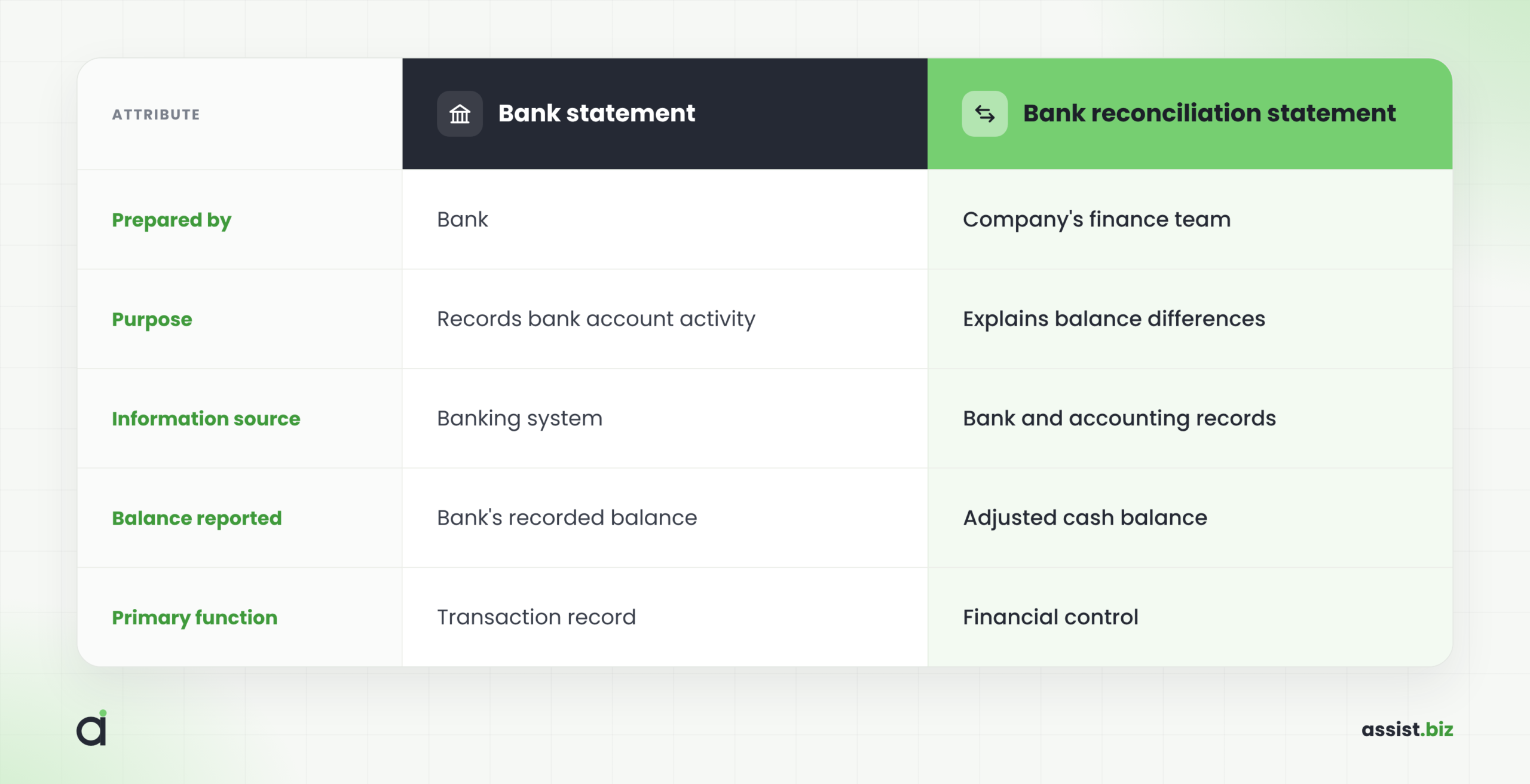
A bank statement shows what the bank has recorded. A reconciliation statement determines whether those records agree with the company’s accounts after valid adjustments.
Bank reconciliation statement formula and common adjustments
Preparing a bank reconciliation statement involves calculating two adjusted balances: one based on the bank statement and another based on the company’s general ledger.
Adjusted bank balance:
Bank statement balance + deposits in transit − outstanding payments ± bank error adjustments
Adjusted book balance:
General ledger balance + unrecorded receipts − unrecorded payments ± book error adjustments
Both adjusted balances should agree once all relevant reconciling items have been identified.
Bank-side and book-side adjustments
Deposits in transit are receipts recorded in the company’s accounts but not yet credited by the bank. Outstanding payments are payments recorded by the company that have not yet cleared its bank account.
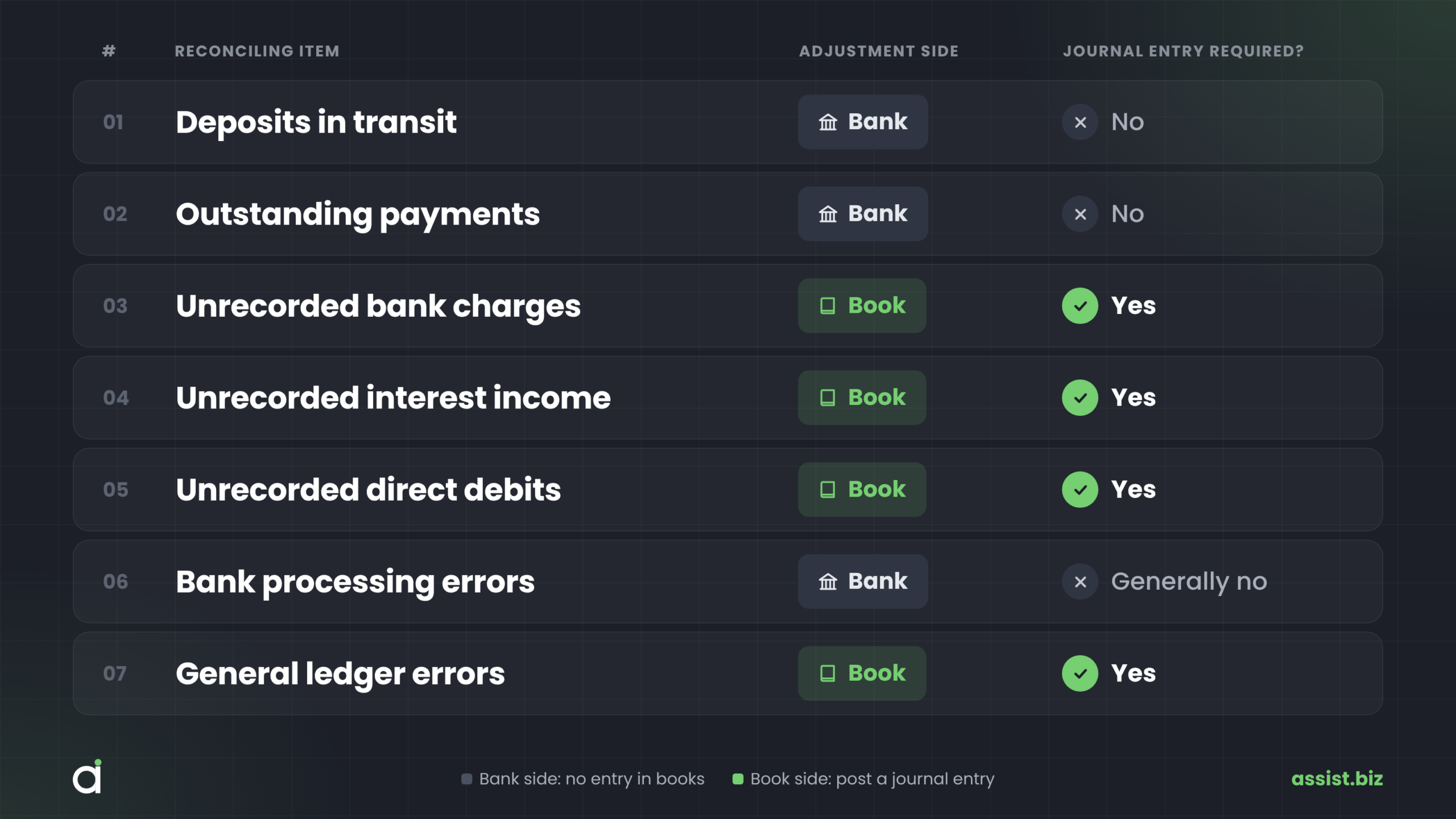
Timing differences do not normally require additional journal entries if the original transactions have already been recorded correctly. Posting them again would create duplicate entries.
Bank reconciliation statement example in Singapore
Suppose a Singapore company is preparing its October financial statements. Its bank statement shows SGD 1,250,000, while its general ledger reports SGD 1,295,500.
The accounting team identifies deposits in transit, outstanding supplier payments, unrecorded bank charges and interest income.
Sample bank reconciliation statement as at 31 October 2026
The following example uses hypothetical figures.
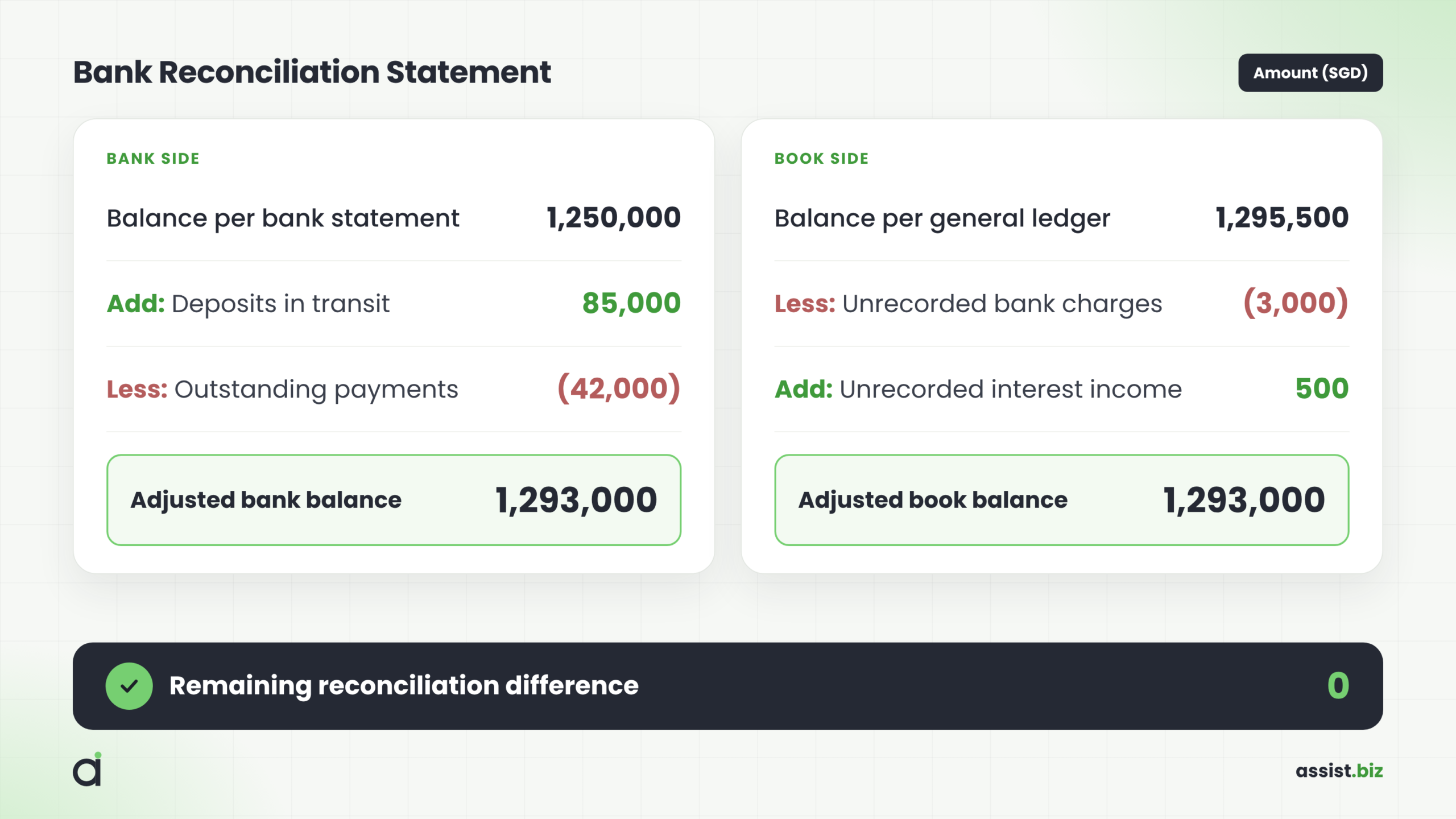
Both adjusted balances agree at SGD 1,293,000. The finance team must still post the book adjustments and verify that the remaining timing differences are legitimate.
Journal entries required after bank reconciliation
Assuming neither the bank charges nor interest income has been recorded, the company should prepare the following entries.
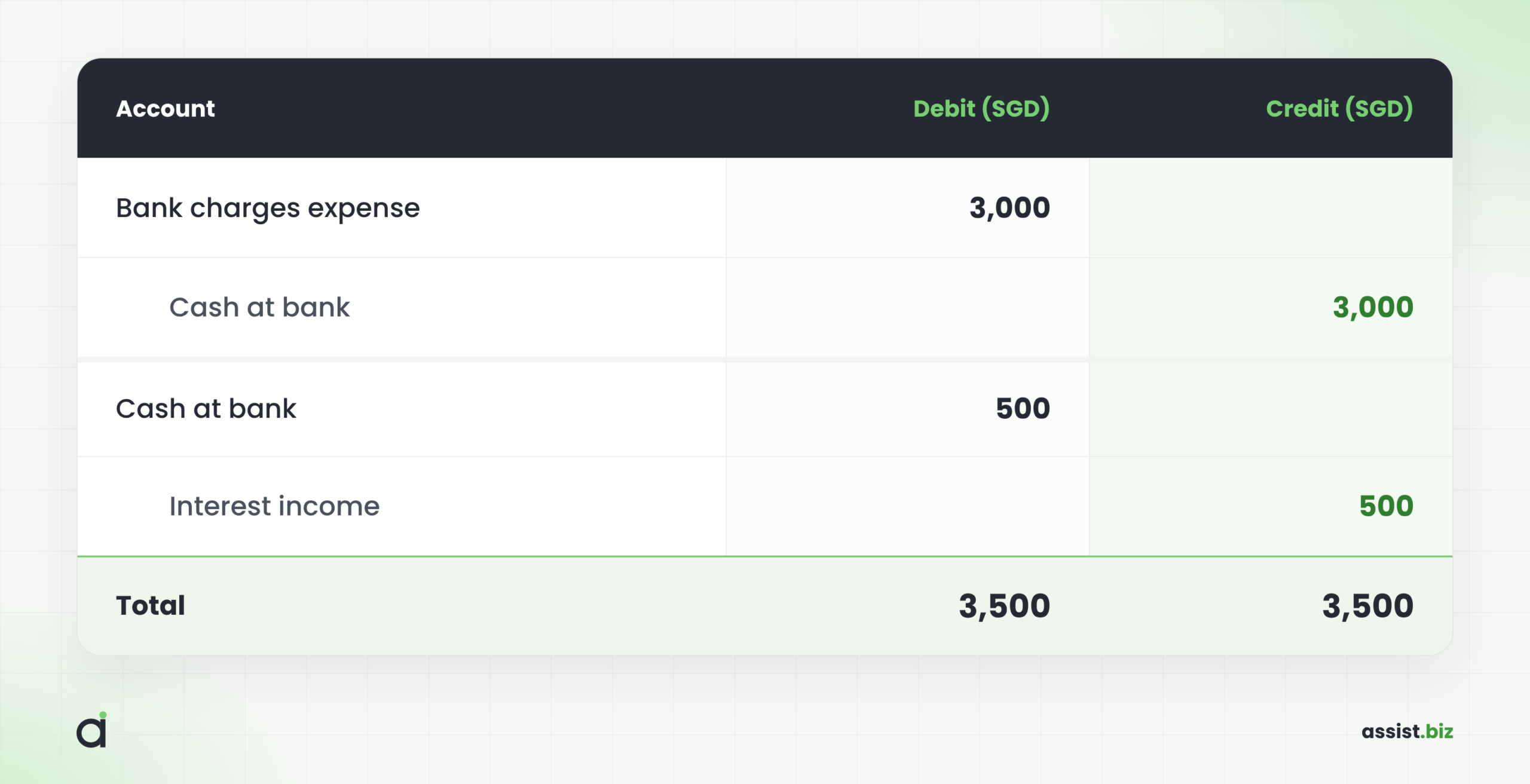
Companies can use this reconciliation statement format as a template by adding the legal entity name, bank account reference, currency, reporting period, supporting document references and reviewer approval fields.
How to prepare a bank reconciliation statement
A consistent procedure helps finance teams identify discrepancies without unnecessarily delaying financial reporting.
- Gather bank statements, general ledger extracts, payment confirmations and the previous reconciliation schedule.
- Verify opening balances against the previous period’s records and review outstanding items carried forward.
- Match receipts and payments using transaction amounts, dates, payment references and settlement details.
- Identify outstanding transactions. Separate genuine timing differences from missing or incorrectly recorded entries.
- Investigate discrepancies, including duplicate payments, unidentified receipts and incorrect amounts. Retrieve the underlying invoices and payment approvals where necessary.
- Record authorised adjusting journal entries for unrecorded charges, interest income, direct debits and accounting errors.
- Calculate both adjusted balances and investigate any unexplained difference.
- Obtain independent approval and retain the reconciliation statement with its supporting records. Assign responsibility and follow-up dates for outstanding items.
The difficult part is often identifying the transaction behind an unfamiliar bank reference. Several customer invoices may have been settled through a single payment, leaving the finance team to reconstruct the allocation.
When assessing financial document processing workflows, consider how invoice information, supporting records and accounting entries can be traced back to the original transaction.
Avoid posting an arbitrary adjustment simply to eliminate a difference. An unsupported journal entry can conceal the accounting problem rather than resolve it.
Bank reconciliation requirements in Singapore
Singapore companies have statutory responsibilities concerning accounting records and financial reporting. Bank reconciliation supports these responsibilities by providing evidence that recorded cash balances have been reviewed.
Companies Act 1967 and IRAS record retention
Under Section 199 of the Companies Act 1967, companies must maintain accounting records sufficient to explain their transactions and financial position and enable the preparation of true and fair financial statements.
Applicable records must be retained for at least five years from the end of the financial year in which the relevant transactions or operations were completed. Public companies and subsidiaries of public companies are also subject to specific internal accounting control requirements.
Separately, the Inland Revenue Authority of Singapore (IRAS) requires companies to retain relevant accounting records and supporting documents for at least five years from the relevant Year of Assessment (YA).
Finance teams should account for both retention periods when establishing document retention policies.
How often should companies reconcile bank accounts?
Singapore’s general corporate accounting legislation does not prescribe a universal monthly bank reconciliation schedule for every company. An appropriate frequency depends on transaction volumes, financial risks and applicable regulatory obligations.
| Frequency | Suitable circumstances |
| Daily | High-volume collections and higher-risk accounts |
| Weekly | Active operational and supplier payment accounts |
| Monthly | Formal period-end reconciliation and financial reporting |
Companies in regulated industries should confirm whether additional sector-specific requirements apply.
Managing bank reconciliation across large companies
Enterprise reconciliation becomes more demanding when several legal entities, currencies and banking relationships feed into the same financial reporting process.
Reconciling multiple bank accounts, currencies and subsidiaries
Each bank account should be reconciled against its corresponding accounting records before its balance is incorporated into consolidated group reporting.
Singapore payment channels such as PayNow Corporate, FAST and GIRO have different transaction references and settlement arrangements. Finance teams should configure matching rules accordingly, particularly when customers settle multiple invoices through one payment.
Companies adopting InvoiceNow electronic invoicing in Singapore should also distinguish electronic invoice records from evidence of actual payment. Receiving a structured electronic invoice does not establish that the corresponding funds have cleared the bank.
For foreign currency accounts, reconcile transactions in the account’s currency and account for exchange rate differences under the applicable accounting standards. Currency translation differences should not be mistaken for missing transactions.
Internal controls and exception management
A zero reconciliation difference does not automatically mean that every transaction was properly authorised.
Large companies should maintain the following controls:
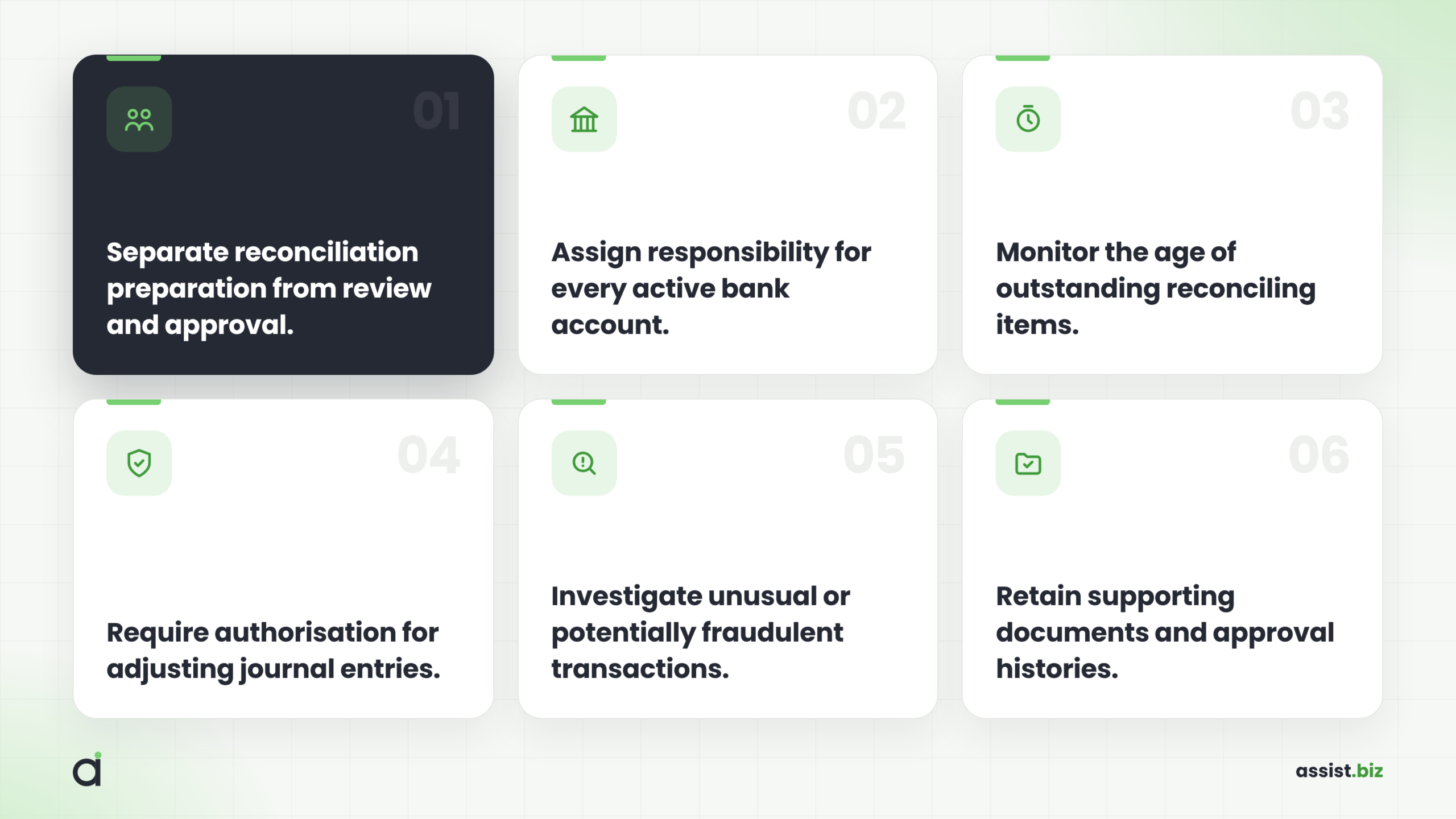
When evaluating accounting automation features and capabilities, finance managers should examine how document handling, approval procedures and accounting records support existing internal controls.
Long-outstanding items deserve particular attention. A payment that remains uncleared across several reporting periods may indicate a cancelled transaction, an accounting error or an issue requiring further investigation.
Manual vs automated bank reconciliation
Manual reconciliation can work for companies with relatively simple transaction records. Comparing thousands of banking entries against spreadsheets, however, can consume considerable staff time.
Automated bank reconciliation uses software to compare banking transactions against accounting records through configured matching rules. Unmatched transactions are flagged for further investigation.
| Criteria | Manual reconciliation | Automated reconciliation |
| Transaction matching | Individual comparison | Configured matching rules |
| Processing capacity | Staff-dependent | Supports larger volumes |
| Exception identification | Manual investigation | System-generated flags |
| Error exposure | Data entry and oversight | Configuration and integration errors |
| Audit trail | Manually maintained | System-generated where supported |
| Human oversight | Required | Still required |
What enterprises should look for in reconciliation automation
Finance teams should evaluate bank feeds, ERP compatibility, one-to-many transaction matching, exception reporting, access permissions and approval workflows.
For companies on cloud accounting platforms, check how Xero accounting integration handles supporting financial records, since gaps between document processing and transaction recording tend to surface at reconciliation.
QuickBooks users should apply the same test, reviewing whether QuickBooks accounting integration carries supporting documents through to the recorded transactions.
Companies using SAP or Oracle should assess compatibility with their existing ERP configuration and bank statement import processes. Accounting integration alone does not guarantee automated bank reconciliation.
Three useful operational metrics are:
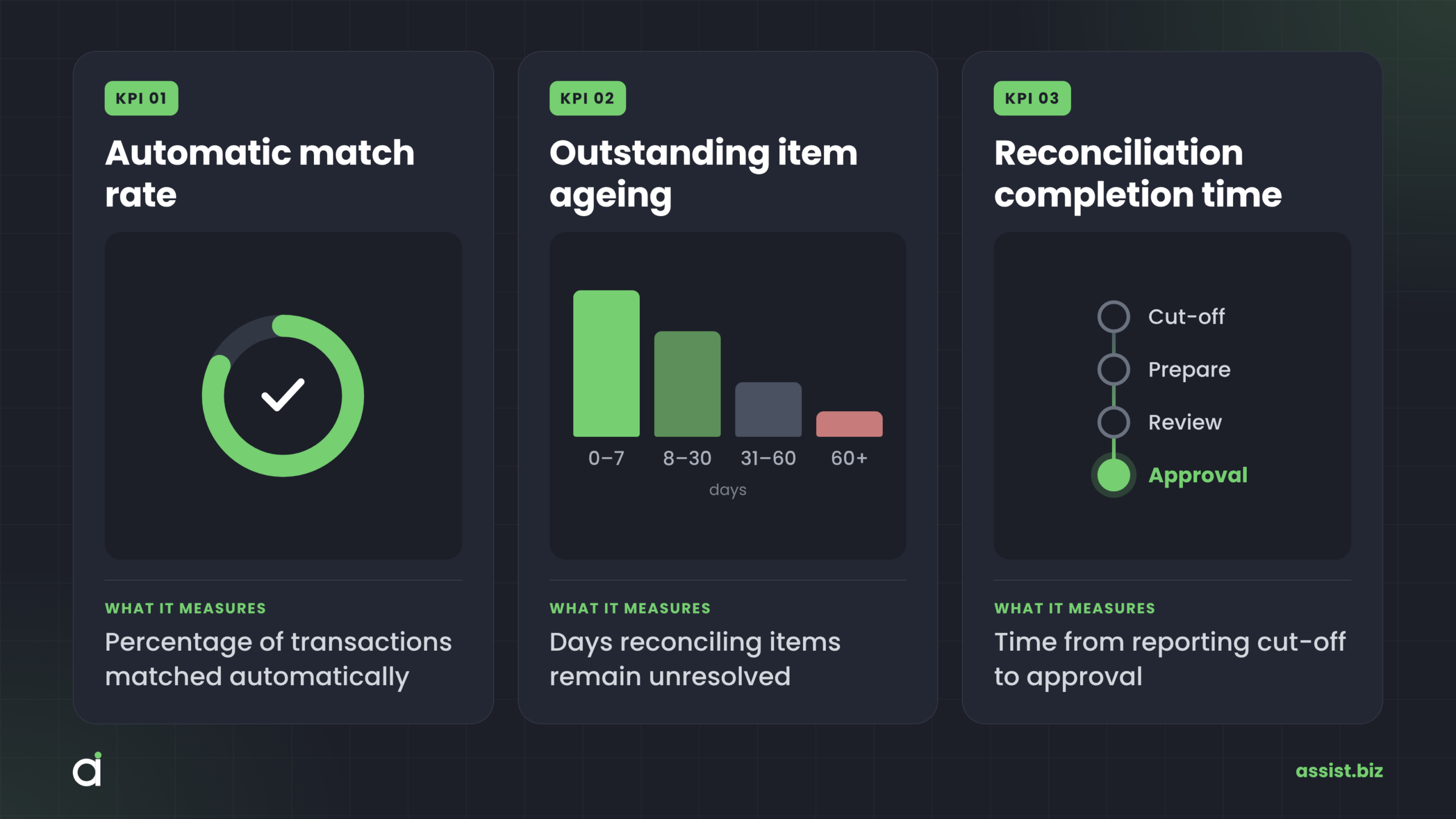
A high automatic match rate is useful only when the matching rules are reliable. Incorrect matches can conceal discrepancies, which is why independent review remains necessary.
Building a more reliable financial close
A reliable bank reconciliation statement depends on accurate accounting records and accessible supporting documents. For Singapore enterprises looking to improve the financial workflows that support reconciliation, Assist.biz offers AI-powered bookkeeping solutions focused on financial document processing and accounting automation.
If your finance team is assessing its readiness for accounting automation, talk to an infrastructure specialist about AI readiness.