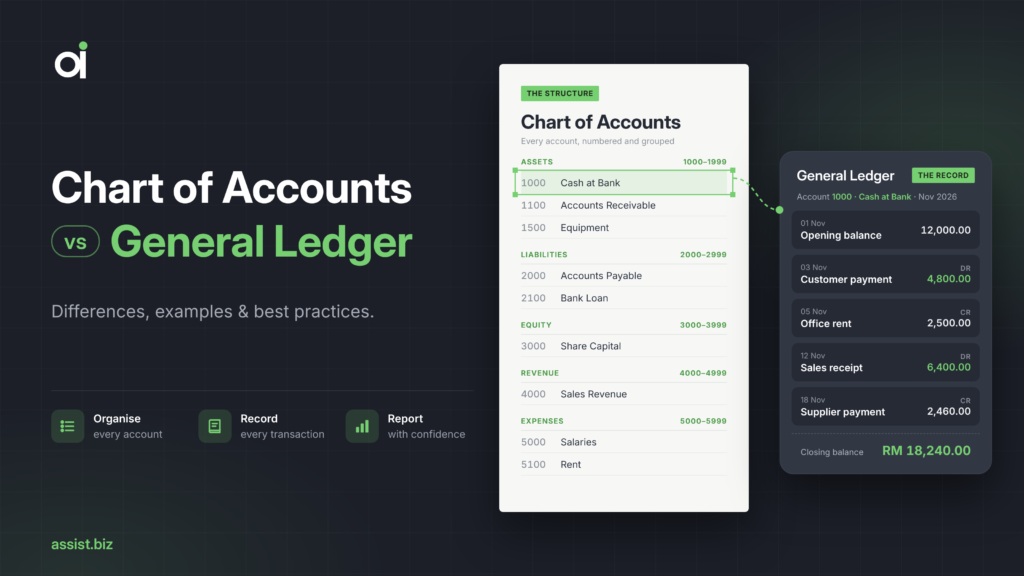





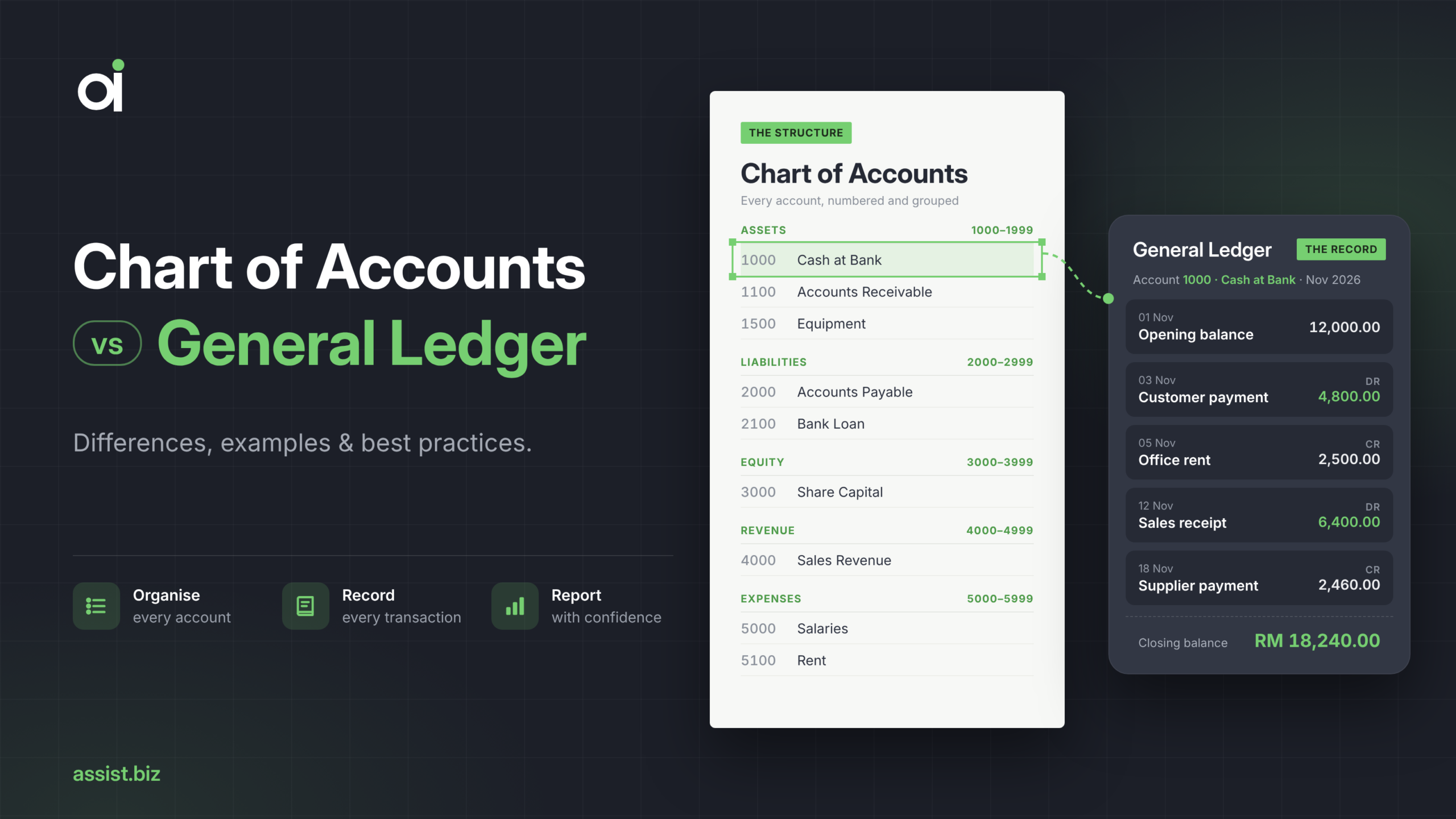

Chart of Accounts vs General Ledger: Differences, Examples & Best Practices
A company’s books can balance perfectly and still contain accounting errors. For Singapore finance teams managing hundreds or thousands of transactions, the problem is often not the numbers themselves but how those numbers are classified and recorded.
An equipment purchase incorrectly classified as an operating expense, for example, may leave debits and credits equal while distorting financial statements. Multiply that across departments or subsidiaries, and seemingly small classification mistakes can complicate reporting, reconciliation, and month-end closing.
This is why understanding Chart of Accounts vs General Ledger matters beyond basic bookkeeping.
The Chart of Accounts (COA) defines how financial transactions are classified, while the General Ledger (GL) records those transactions and their financial impact. Together, they form the foundation of accurate accounting, reliable reporting, and effective financial controls.
This guide explains their differences, how they work together, and the best practices Singapore finance teams can apply to improve financial accuracy and operational efficiency.
What Is a Chart of Accounts (COA)?
A Chart of Accounts (COA) is an organised list of accounts that a business uses to classify financial transactions.
Think of it as the framework behind your accounting system. Each account has a name, typically a unique code, and a classification that determines how transactions are grouped for financial reporting.
Most organisations arrange their COA into five main categories:
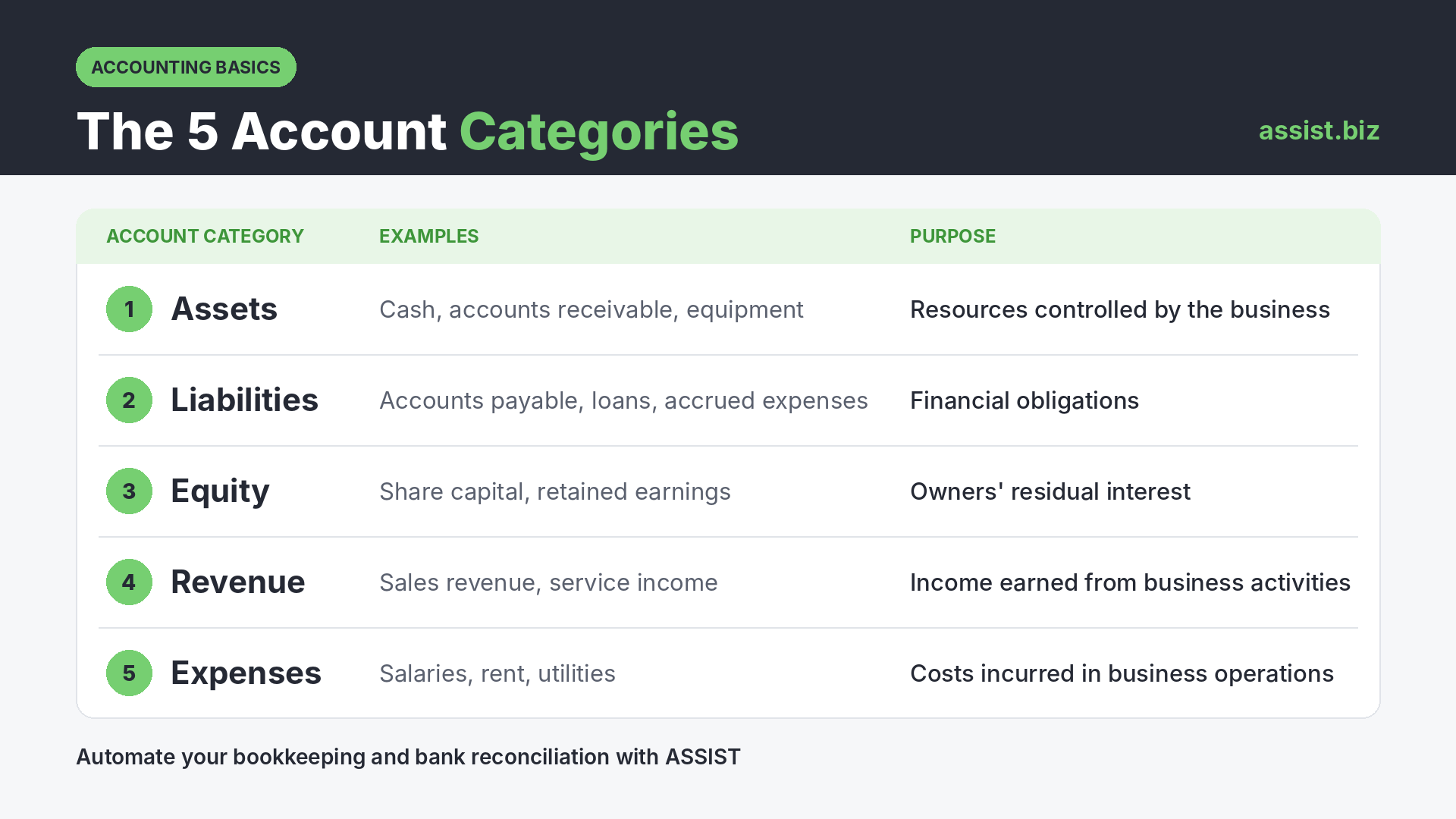
For example, a Singapore company might assign account code 6100 to Office Expenses and 6200 to Professional Fees. These account numbers are illustrative. Singapore businesses are not required to follow a universal COA numbering system.
For larger enterprises, the COA may also support reporting across legal entities, departments, business units, and cost centres. Modern accounting systems often manage some of these dimensions separately, avoiding the need to create excessive numbers of GL accounts.
A well-designed COA allows finance teams to classify transactions consistently, compare financial performance, and generate meaningful reports. However, the COA itself does not record individual transactions. That responsibility belongs to the General Ledger.
What Is a General Ledger (GL)?
A General Ledger (GL) is the central accounting record containing financial transactions posted to a company’s accounts.
While the COA determines which accounts exist, the GL shows the financial activity recorded against them. A typical GL entry includes transaction date and reference number, account code and description, debit or credit amount, transaction details, and supporting-document references.
Consider a Singapore company paying S$3,000 in monthly office rent, assuming no GST for this simplified example. The journal entry would be:
| Account | Debit | Credit |
| Rent Expense | S$3,000 | — |
| Bank | — | S$3,000 |
| Total | S$3,000 | S$3,000 |
The COA provides the Rent Expense and Bank accounts, while the GL records the actual transaction and updates their balances.
Finance teams rely on GL information to prepare trial balances, perform reconciliations, investigate discrepancies, and support financial statement preparation.
For enterprises handling large transaction volumes, reliable ledger management also depends on accurate source information. This is why many finance departments are examining how digital document capture and accounting workflows can support the movement of financial information from source documents into their accounting processes.
Chart of Accounts vs General Ledger: Key Differences
Although the COA and GL work closely together, their functions are fundamentally different.
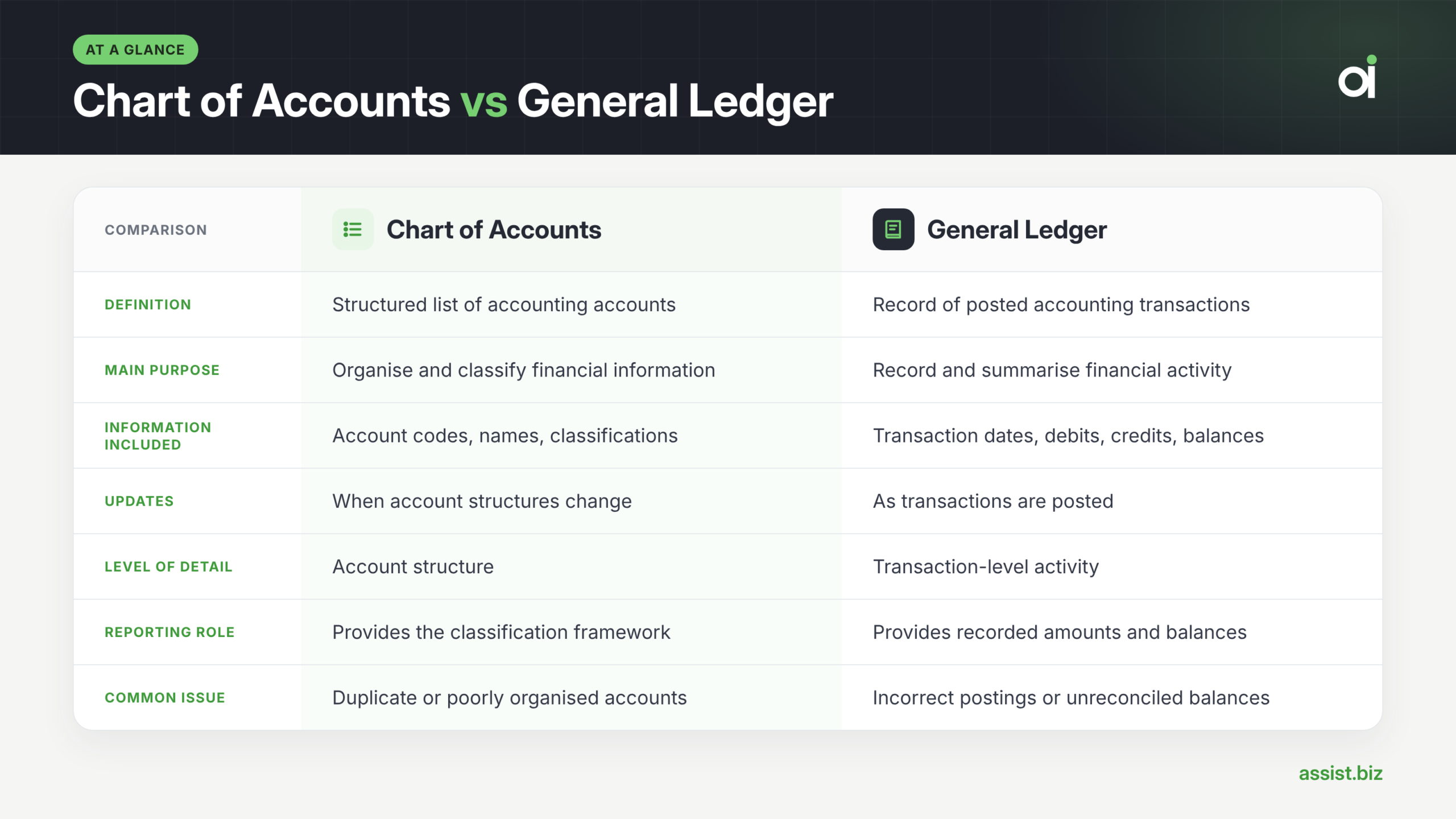
The simplest way to understand the difference is: The Chart of Accounts tells finance teams where a transaction belongs. The General Ledger shows what was actually recorded.
Neither can function effectively without the other. A poorly structured COA creates inconsistent classifications, while inaccurate GL postings undermine financial reports even when the account structure is properly designed.
How Do the Chart of Accounts and General Ledger Work Together?
Consider a Singapore business purchasing office equipment worth S$10,000, excluding GST. Assume the equipment qualifies for capitalisation under the company’s accounting policy and the business can fully claim the 9% input GST.
Step 1: Identify the correct COA accounts
| Account code | Account name | Classification |
| 1500 | Office Equipment | Asset |
| 1300 | GST Input Tax | Asset |
| 2100 | Accounts Payable | Liability |
These codes are examples rather than mandatory Singapore account numbers.
Step 2: Record the transaction in the GL
| Account | Debit | Credit |
| Office Equipment | S$10,000 | — |
| GST Input Tax | S$900 | — |
| Accounts Payable | — | S$10,900 |
| Total | S$10,900 | S$10,900 |
The transaction balances, and each amount has been assigned to its appropriate account.
Step 3: Reflect the transaction in financial reporting
The equipment is recognised as an asset, subject to the company’s applicable accounting policies. The payable represents the amount owed to the supplier, while the recoverable GST is recorded separately.
But imagine the equipment was incorrectly posted to Repairs and Maintenance. The journal would still balance. However, expenses could be overstated, assets understated, and subsequent depreciation accounting affected.
This demonstrates an important principle: a balanced General Ledger does not necessarily mean the accounting treatment is correct. Accurate results depend on correct account selection, supporting documentation, and appropriate review procedures.
For businesses processing significant numbers of supplier invoices, understanding the relationship between invoice management, document classification, and accounting integration can help identify where errors commonly enter the workflow.
Common Chart of Accounts and General Ledger Mistakes
Even experienced finance teams can encounter accounting problems when transaction volumes increase or reporting structures become more complex.
1. Assigning incorrect GL codes
A supplier invoice may be recorded under the wrong expense or asset account, particularly when coding is performed manually. For example, software implementation costs might be classified entirely as routine IT expenses without evaluating whether any portion qualifies for capitalisation.
These mistakes can affect financial reporting, management analysis, and subsequent accounting adjustments. To reduce inconsistencies, finance teams should establish clear account-coding rules, maintain reliable supplier information, and review unusual transactions before posting.
2. Creating duplicate or unnecessary accounts
When departments independently request new accounts, similar expenses may be recorded under different codes. For instance, one team might use Software Subscriptions while another uses SaaS Expenses for equivalent transactions.
This fragmentation makes financial analysis more difficult and can complicate group reporting. A centralised account approval process helps prevent duplicate accounts and maintains consistent classifications.
3. Failing to reconcile GL balances
A balanced journal entry does not guarantee that recorded balances agree with bank statements, supplier records, or other supporting evidence. Regular reconciliations help identify missing transactions, duplicate postings, timing differences, and unexplained balances.
For finance departments managing high transaction volumes, reviewing automated bookkeeping and financial document management capabilities can provide useful context when evaluating ways to reduce repetitive administrative work.
However, reconciliation still requires appropriate controls, investigation of discrepancies, and approval of necessary adjustments.
4. Maintaining inconsistent account structures across subsidiaries
A group operating across Singapore and other APAC markets may have different account structures in each entity. Without a standardised reporting framework or reliable account mapping, finance teams can spend considerable time consolidating financial information.
The solution is not necessarily to force every subsidiary to use identical account codes. A controlled group mapping structure can accommodate local requirements while maintaining consistent consolidated reporting.
Why COA and GL Accuracy Matters in Singapore
For Singapore finance teams, accurate accounting records support more than internal management reporting. They are also important for financial statement preparation, GST administration, and statutory record-keeping obligations.
Financial reporting under Singapore accounting standards
Singapore companies prepare financial statements using applicable accounting frameworks, including Singapore Financial Reporting Standards (International), or SFRS(I), and Financial Reporting Standards (FRS).
The Accounting and Corporate Regulatory Authority (ACRA) provides information about Singapore’s financial reporting requirements.
Although these standards do not prescribe a universal COA numbering system, accurate account classification is necessary for preparing reliable financial statements. For example, incorrect classification between operating expenses and capital assets can affect reported profitability and financial position.
For enterprises, consistent accounting structures also support comparisons between reporting periods, departments, and subsidiaries.
GST accounting and tax classification
Singapore’s GST system adds another important consideration. A GL account code determines where a transaction is recorded in the accounting system. A GST tax code determines the applicable tax treatment. These are separate decisions.
An invoice can be assigned to the correct expense account but still contain an incorrect GST code, potentially affecting GST reporting or input tax claims. Finance teams should therefore validate both account classification and tax treatment.
Singapore’s InvoiceNow e-invoicing framework is also becoming increasingly relevant as GST-registered businesses transition towards structured electronic invoice-data submission.
Under the GST InvoiceNow Requirement, implementation is being phased in across GST-registered businesses, with further onboarding stages scheduled through April 2031. Businesses should consult the latest IRAS guidance to determine their applicable requirements and deadlines. However, electronic invoice-data submission does not replace the need to maintain accurate General Ledger records.
Record-keeping and audit readiness
The Inland Revenue Authority of Singapore (IRAS) generally requires companies to retain relevant accounting records and supporting documents for at least five years from the relevant Year of Assessment. These records may include invoices, bank statements, accounting entries, and transaction schedules.
For finance teams, this reinforces the importance of maintaining a clear connection between source documents, accounting entries, and financial reports. A well-maintained GL makes it easier to trace transactions, investigate discrepancies, and respond to audit enquiries.
Best Practices for Managing the COA and General Ledger
Standardise account names and coding rules
Establish clear account definitions and guidelines for commonly used expense, revenue, asset, and liability accounts. Finance teams should understand when an account should be used and when an alternative classification is appropriate. Documented coding rules also help maintain consistency when new employees join the finance department or when transaction processing is shared across teams.
Review the COA regularly
Periodically identify duplicate, inactive, or unnecessary accounts. Before creating a new account, consider whether an existing account or separate reporting dimension can meet the requirement. For multi-entity organisations, finance controllers should also review account mappings to ensure consolidated reporting remains consistent. Your accounting software should let you adjust the COA easily; our guide to accounting software for small businesses lists what else to check.
Establish approval controls
Changes to account structures and significant journal entries should follow defined approval procedures. Role-based access and segregation of duties help reduce unauthorised changes and improve accountability.
Reconcile accounts consistently
Perform regular reconciliations between GL balances and supporting records. High-risk accounts, including cash, receivables, payables, and tax balances, may require more frequent review. Clear reconciliation ownership and deadlines can help finance teams identify unresolved differences before month-end closing.
Maintain reliable supporting documentation
Ensure invoices, receipts, contracts, and approval records can be linked to relevant accounting entries. This supports internal controls and reduces the time required to investigate unusual transactions.
For teams using cloud accounting platforms, understanding how invoice processing integrates with Xero can also inform decisions about document traceability, account mapping, and reducing duplicate data entry.
How Automation Supports Accurate GL Coding
For finance teams processing large volumes of invoices, manual GL coding can become a repetitive and time-consuming activity. Each invoice may require someone to identify the supplier, extract relevant information, determine the correct account, check GST treatment, and prepare the transaction for posting.
As transaction volumes increase, maintaining consistent coding becomes more challenging. Modern accounting automation can support these activities through document extraction, predefined coding rules, and AI-assisted account suggestions.
From document capture to accounting entries
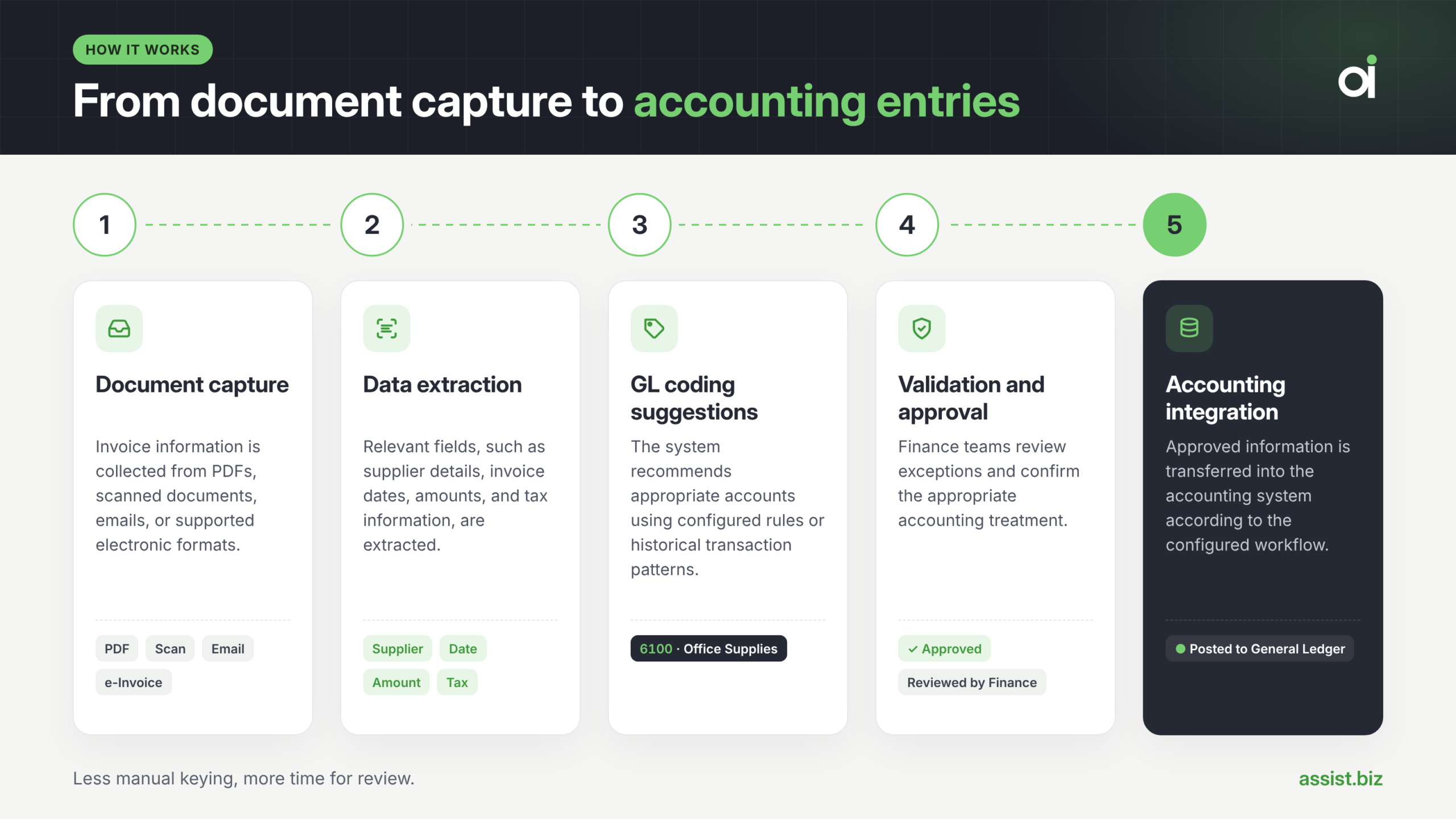
For example, a recurring office rental invoice might receive a suggested account based on previously approved transactions. An unfamiliar supplier, unusual invoice amount, or inconsistent tax treatment could instead trigger additional review.
This approach can help reduce repetitive data entry while allowing finance teams to maintain control over accounting decisions.
The importance of accounting system integration
Automation becomes more useful when financial information can move reliably between invoice-processing systems and accounting platforms.
For organisations using QuickBooks, understanding how invoice workflows connect with QuickBooks can help finance teams evaluate how transaction information is transferred and reviewed.
However, integration alone does not guarantee accounting accuracy. Incorrect account mappings, incomplete supplier information, or poorly configured rules can still produce inaccurate entries.
Finance teams should therefore monitor coding accuracy, manual correction rates, exception volumes, and reconciliation results. The objective is not to replace accounting judgement. It is to reduce repetitive processing so finance professionals can devote more attention to exceptions, financial controls, and business analysis.
Frequently Asked Questions
1. Is a Chart of Accounts the same as a General Ledger?
No. Think of the COA as the index and the GL as the book: one names the accounts, the other holds every entry and balance posted to them.
2. Can a General Ledger balance and still contain errors?
Yes. Equal debits and credits only prove an entry is arithmetically complete, not that it was posted to the right account, in the right period, or only once.
3. What is the difference between a GL code and a GST tax code?
The GL code shapes your financial statements, while the GST tax code shapes your GST return, so check both on every invoice because getting one right says nothing about the other.
4. Should all subsidiaries use the same Chart of Accounts?
Not always. A single group COA suits subsidiaries with similar operations, while entities with distinct local reporting needs can keep their own codes if each one maps cleanly to the group structure.
5. How often should finance teams review their COA?
Finance teams should review their COA periodically and whenever significant operational, organisational, or reporting changes occur. The appropriate frequency depends on business complexity and transaction volumes.
6. Can AI automatically assign GL codes?
AI can suggest a GL code, but a person should still approve it, especially for new suppliers, unusual amounts, or costs that may need to be capitalised.
Conclusion: Better Accounting Starts With Better Classification
Understanding the difference between a Chart of Accounts and a General Ledger helps finance teams build more reliable accounting processes. The COA provides the structure for classifying financial activity, while the GL records the transactions that support financial reporting.
For Singapore enterprises, maintaining both accurately is essential for consistent reporting, reconciliation, GST administration, and financial control.
As transaction volumes grow, manual invoice processing and GL coding can create unnecessary administrative work. ASSIST helps finance teams simplify these processes through AI-assisted document capture, GL coding automation, approval workflows, and accounting integrations. To see how these capabilities could support your existing finance operations, book a personalised ASSIST demo.