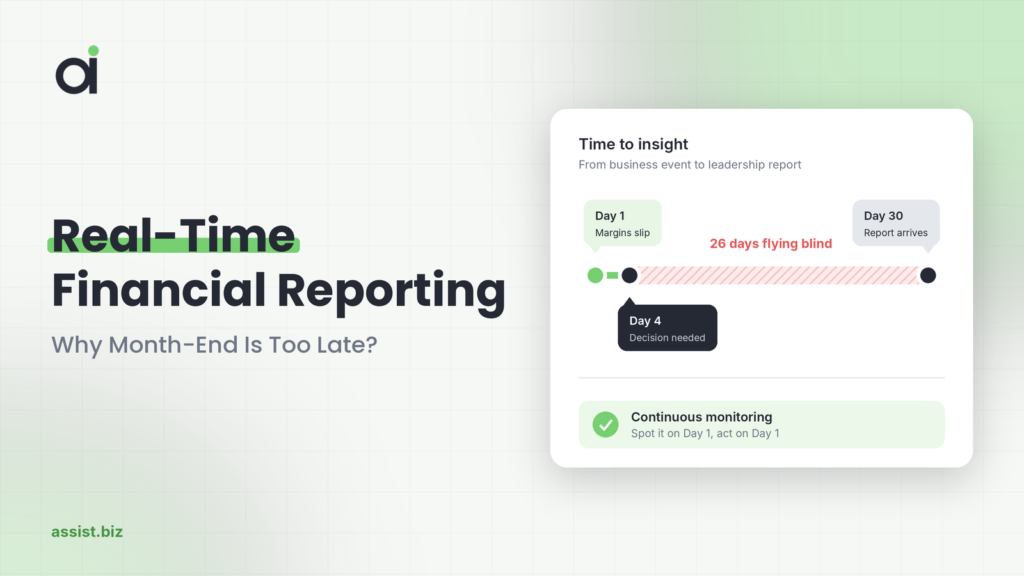






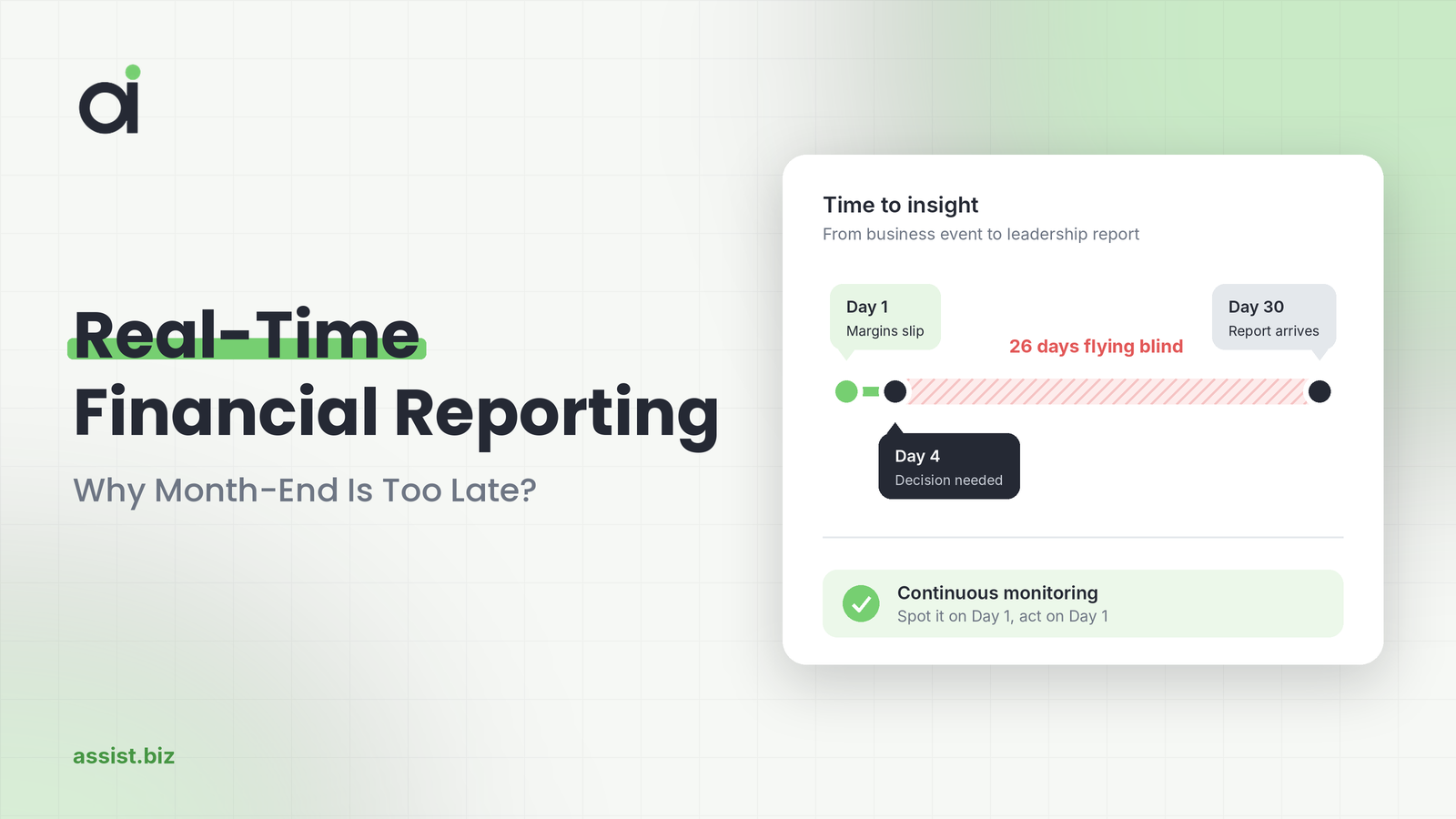

By the time your finance team delivers the monthly report, supplier costs may have increased, customer demand may have shifted, and cash flow risks may already be developing. For large enterprises, these changes can affect profitability and operations long before they appear in consolidated financial statements.
This is the reporting lag problem: the gap between what is happening across the business and what leadership knows about it.
For Singapore enterprises managing multiple subsidiaries, regional operations, and complex financial systems, delayed information can lead to missed opportunities, slower responses, and unnecessary financial exposure.
Month-end closing remains essential for accurate accounting, governance, and compliance. However, waiting until the books are closed to understand business performance is no longer sufficient.
The challenge is not simply producing financial reports faster. It is giving leadership reliable, decision-ready information while there is still time to act.
What Is the Reporting Lag Problem?
Reporting lag occurs when there is a delay between a business event and the availability of relevant information to decision-makers.
Consider a Singapore-headquartered enterprise operating across Southeast Asia. A major supplier increases prices early in the month, affecting procurement costs across several subsidiaries.
The transactions are recorded correctly, but their combined impact on profitability becomes visible only after monthly consolidation.
By then, weeks of purchases may already have occurred at higher prices.
The information existed within the organisation. It simply did not reach the right people soon enough.
This introduces an important concept: decision latency, the time between a significant business event and an informed management decision.
Decision latency involves four stages:
- Detection: Identifying a meaningful change.
- Interpretation: Understanding its financial or operational significance.
- Escalation: Bringing the issue to the appropriate decision-maker.
- Action: Deciding and implementing an appropriate response.
Financial closing establishes accurate accounting records. Management reporting communicates performance. Continuous financial intelligence helps leaders recognise important changes between reporting cycles.
Large enterprises need all three.
Why Month-End Close Leaves Leadership Looking Backward
Traditional month-end closing involves transaction validation, reconciliations, accounting adjustments, consolidation, and management reporting.
These activities protect financial integrity, but they can also delay the availability of information.
According to APQC’s monthly consolidation benchmark, the cross-industry median time to complete monthly consolidated financial statements is roughly six calendar days.
Importantly, this measures the consolidation process, not the entire period between a business event and a leadership decision.
For large enterprises, several factors contribute to reporting delays.
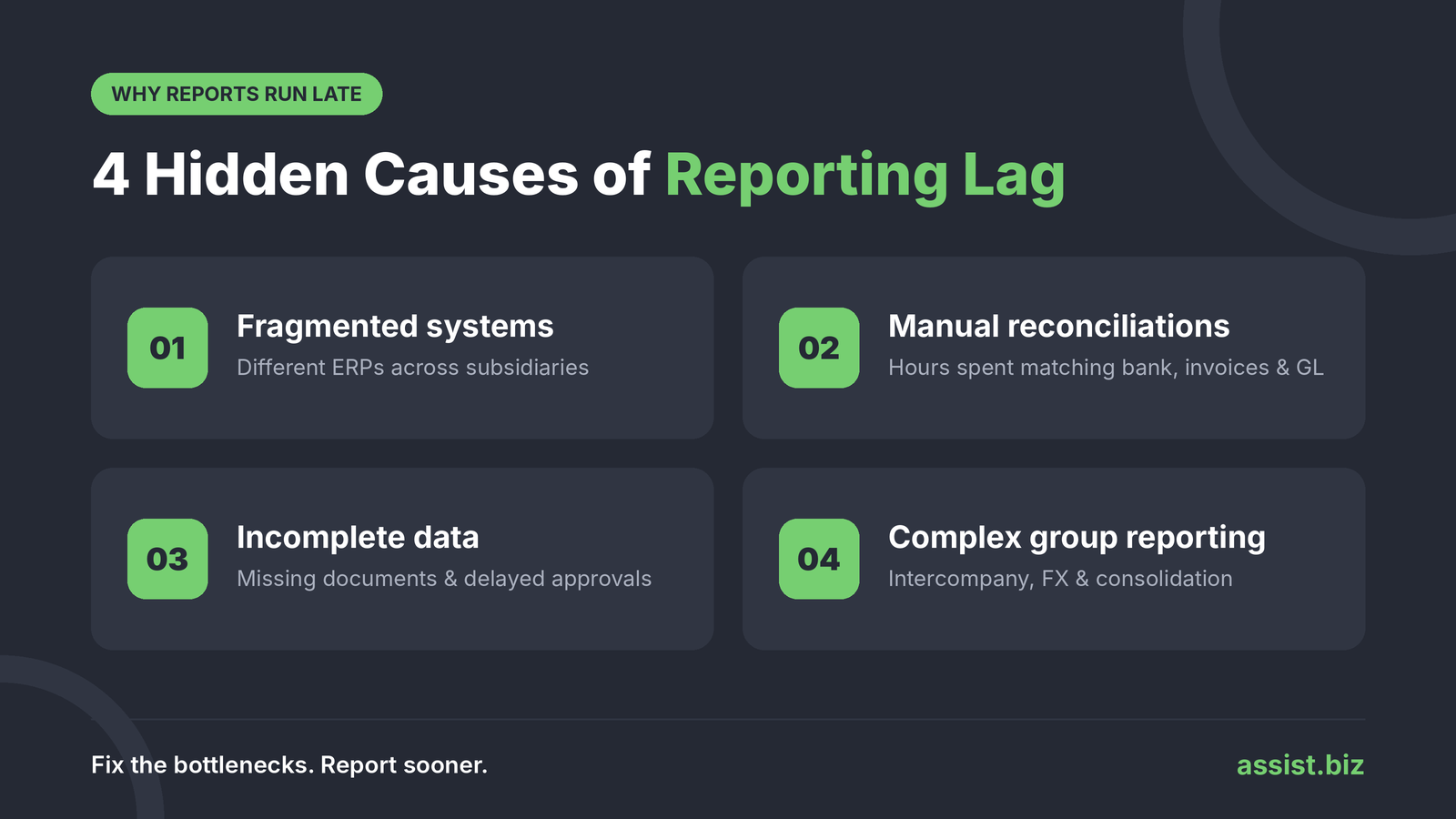
Many of these problems begin before month-end.
For example, inefficient invoice processing can create incomplete records that require investigation during reconciliation. This is why understanding the role of automated finance and document processing is relevant when evaluating ways to improve transaction accuracy and reduce manual processing delays.
However, improving accounting efficiency alone is insufficient. Enterprises must also reconsider when financial information becomes available for management decisions.
The Hidden Business Costs of Delayed Financial Information
Reporting delays rarely appear as a separate expense in financial statements. Their consequences emerge through slower responses, missed opportunities, and operational inefficiencies.
1. Margin Erosion Goes Unnoticed
Consider a regional manufacturing group experiencing rising raw material costs.
Individual transactions are recorded correctly, but the cumulative effect on product margins becomes apparent only during monthly variance analysis.
By the time management identifies the trend, the company may have continued purchasing at higher prices without reviewing its procurement strategy.
Earlier visibility allows finance and procurement teams to investigate cost movements, assess margin exposure, and consider alternative purchasing arrangements.
The objective is not to react to every price fluctuation. It is to identify material changes before they become larger financial problems.
2. Cash Flow Risks Become Visible Too Late
Cash flow management depends on understanding outstanding receivables, expected collections, and upcoming payment obligations.
When this information is reviewed primarily at month-end, collection problems can develop without sufficient management attention.
For example, several major customers may begin extending payment periods simultaneously.
Individually, these delays might appear manageable. Collectively, they could increase working capital requirements.
More frequent monitoring of overdue invoices, payment behaviour, and outstanding obligations helps finance teams recognise emerging pressure. This makes AI-powered bookkeeping and financial organisation relevant to enterprises evaluating how to maintain more consistent transaction records and improve financial visibility.
3. Revenue Changes Are Discovered After the Fact
Revenue reports explain how much a company earned during a reporting period. However, leadership also needs to understand changes in customer behaviour before they materially affect performance.
Imagine a distribution company whose largest customer gradually reduces its order volume.
The sales team may observe individual changes, but senior management might not recognise the broader pattern until consolidated revenue figures are reviewed.
Earlier detection gives account managers an opportunity to investigate customer satisfaction, purchasing behaviour, or competitive pressures.
It does not guarantee that lost revenue can be recovered. It gives the organisation more time to understand the situation and respond appropriately.
4. Operational Bottlenecks Continue Unchecked
Financial reporting delays often originate outside the finance department.
Supplier invoices awaiting approval, incomplete expense submissions, and unresolved purchasing discrepancies can create gaps in financial visibility.
When these issues remain unnoticed until month-end, finance teams face additional reconciliation work while operational delays continue.
For large organisations handling high transaction volumes, streamlined financial approval workflows can help establish accountability, identify outstanding requests, and reduce avoidable processing bottlenecks.
Ultimately, reporting lag is an organisation-wide information challenge, not simply an accounting problem.
Why Reporting Lag Is More Complex for Singapore Enterprises
Singapore is an important regional headquarters location for businesses operating across Southeast Asia.
For large enterprises, financial reporting may involve subsidiaries in Malaysia, Indonesia, Thailand, Vietnam, and other markets.
These entities can operate with different currencies, reporting schedules, tax requirements, and financial systems.
A Singapore headquarters may therefore receive financial information at different times and in inconsistent formats.
For example, one subsidiary might provide updated procurement data daily, while another submits financial information through monthly spreadsheets.
Both entities may operate effectively, yet group leadership still lacks a consistent picture of overall performance.
Intercompany transactions introduce further complexity. Balances between subsidiaries must be reconciled, while currency movements and consolidation adjustments can affect group results.
This makes standardised data definitions, reliable integrations, and clear governance essential.
Where subsidiaries run cloud accounting platforms such as Xero, a direct integration with Xero can keep their transaction data synchronised with group-level reporting instead of relying on manual exports.
Singapore enterprises must also maintain appropriate financial reporting controls.
The Accounting and Corporate Regulatory Authority (ACRA) explains that company directors are responsible for ensuring financial statements comply with applicable accounting standards and present a true and fair view.
Continuous management reporting does not replace these obligations.
Instead, enterprises should distinguish between preliminary operational indicators and final, reconciled financial results.
This allows leadership to act on timely information without compromising the integrity of formal financial reporting.
Why Faster Month-End Closing Alone Is Not Enough
Reducing the monthly closing cycle from ten days to five is a meaningful operational improvement. But it does not necessarily eliminate reporting lag.
A supplier cost increase occurring early in the month could still remain undetected until the following reporting period.
This is why finance transformation must extend beyond accelerating month-end activities.
Continuous close distributes eligible accounting activities throughout the reporting cycle. Rather than concentrating reconciliations, validations, and reviews at month-end, finance teams complete them more frequently.
In its insights on record-to-report transformation, EY Singapore highlights how continuous close approaches can improve financial visibility, forecasting, and organisational agility.
However, continuous reporting is valuable only when the underlying information is trustworthy.
A dashboard refreshed every hour may still be misleading if transactions are missing, classifications are incorrect, or figures have not been validated.
Effective financial visibility requires four elements: timeliness, reliability, interpretation, and actionability.
For enterprise leaders, the goal should be decision-ready information, not simply more frequent reports.
How AI-Powered Financial Intelligence Helps Leaders Act Earlier
Traditional financial dashboards provide useful summaries of revenue, expenses, cash flow, and historical performance.
AI-powered financial intelligence can extend these capabilities by identifying unusual patterns and drawing attention to developments that require investigation.
From Static Dashboards to Proactive Alerts
Consider an enterprise processing thousands of supplier invoices across multiple subsidiaries.
Manually reviewing every transaction for unusual price movements, duplicate entries, or delayed approvals would require substantial effort.
With appropriately configured AI and analytics, finance teams can monitor transaction patterns and flag exceptions based on business rules, historical behaviour, or statistical anomalies.
Similar monitoring can identify customers whose purchasing activity has declined, receivables ageing unexpectedly, or expenses exceeding established thresholds.
These alerts do not automatically prove that something is wrong. They help employees prioritise investigation.
The quality of underlying transaction information remains essential.
For enterprises handling large volumes of invoices and financial documents, reviewing available finance automation capabilities can help clarify how document capture, transaction organisation, and processing workflows contribute to more reliable downstream financial analysis.
Maintaining Trust in AI-Generated Insights
AI adoption introduces additional governance responsibilities, particularly when systems recommend or initiate consequential business actions.
Singapore’s Infocomm Media Development Authority (IMDA) provides AI governance guidance that emphasises accountability, risk management, and appropriate human oversight.
Enterprise finance teams should implement suitable controls, including data-quality checks, access restrictions, explainable alerts, audit trails, and human review.
The objective is not to replace professional judgement.
It is to provide finance leaders with relevant information earlier, allowing them to make better-informed decisions.
Conclusion: Leadership Decisions Should Not Wait for Month-End
Month-end closing remains essential to enterprise financial management. Accurate records, reconciliations, and statutory reporting are fundamental to financial governance.
However, relying exclusively on monthly reports creates an avoidable gap between business activity and leadership awareness.
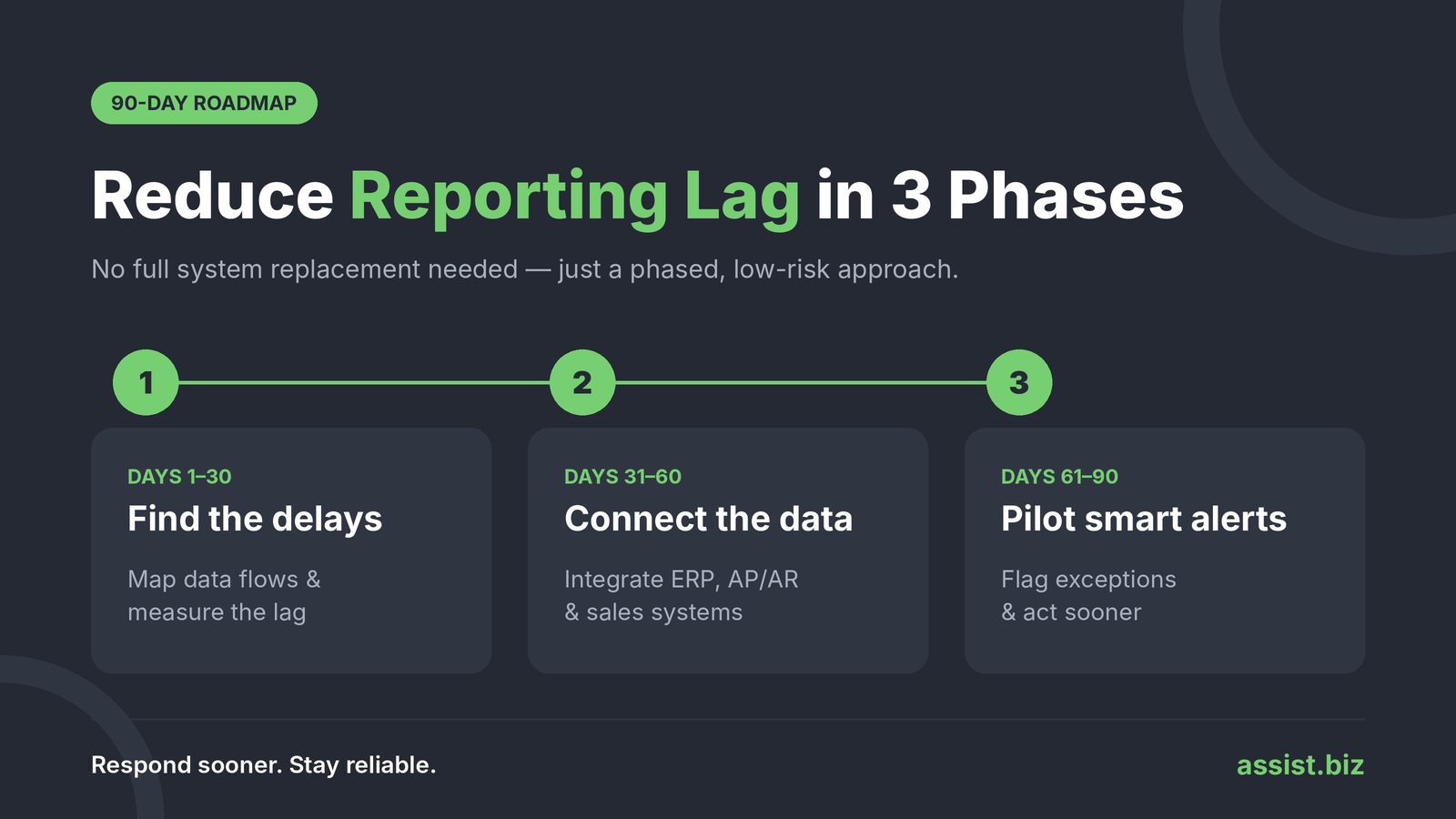
For Singapore enterprises operating across multiple entities and markets, reducing that gap requires reliable data integration, continuous financial visibility, and clear processes for identifying and escalating significant changes.
The future of enterprise finance is not simply about producing reports faster. It is about ensuring decision-makers receive meaningful information while they can still influence outcomes.
For organisations exploring this transition, ASSIST Intelligence provides proactive financial and operational insights designed to highlight unusual changes and emerging issues earlier. To explore how these capabilities could support your existing systems and governance requirements, book an ASSIST demo and speak with the team about AI readiness.